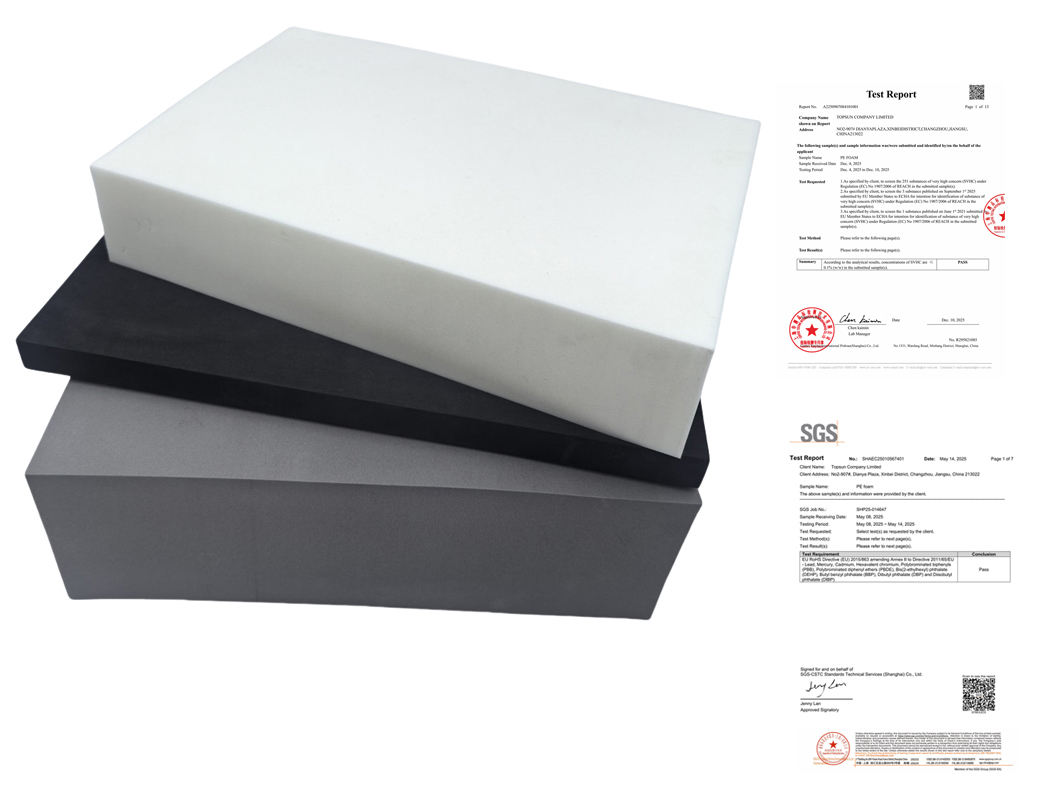
Why International Standards Matter for Industrial Foams
Have you ever wondered why some industrial foams offer superior resistance to fire, compression, chemicals, or harsh environmental conditions while others fall short? The answer often lies in compliance with internationally recognized testing and performance standards.
For professionals working with foam materials in industries such as military, medical, automotive, marine, sports equipment, construction, and educational facilities, understanding these standards is essential. They provide a reliable framework for evaluating product quality, safety, consistency, and performance. In this article, TOPSUN introduces the most important international standards used for industrial foams and explains their significance in a clear and practical way.
What Are International Standards for Industrial Foams?
Industrial foams—including EVA foam, polyethylene foam, EPDM foam, neoprene foam, TPE foam, cross-linked foam sheets, compressed foam, elastic foam, and flexible foam—are used in a wide range of demanding applications. International standards help ensure that these materials meet specific performance requirements and deliver consistent results from one production batch to another.
The two most widely recognized organizations for foam testing and material standards are:
ISO (International Organization for Standardization) – Headquartered in Switzerland, ISO develops globally accepted standards that establish common requirements for quality, safety, and performance across industries and countries.
ASTM International (formerly the American Society for Testing and Materials) – Based in the United States, ASTM publishes highly detailed testing methods and material specifications used extensively throughout manufacturing, engineering, and product development.
Other standards organizations, such as Germany's DIN (Deutsches Institut für Normung) and the United Kingdom's BS (British Standards), also play important roles in specific markets. However, ISO and ASTM standards remain the primary references in international trade and are widely accepted by manufacturers, suppliers, and end users around the world.
Why Are Foam Standards Important for Manufacturers?
Imagine a foam manufacturer seeking to supply products to the military or medical sector. In these industries, materials are rarely accepted without documented compliance with recognized international standards. Standards provide objective evidence that a foam has been tested for safety, performance, and consistency.
Foam standards are important for four main reasons:
●Product Safety: Standards help reduce risks related to flammability, toxicity, chemical reactions, and other potential hazards.
●Consistent Quality: They ensure that materials such as EVA foam maintain uniform properties—such as density, compression performance, and durability—from batch to batch.
●Global Market Access: Foam products tested to ISO and ASTM standards are generally easier to supply to customers in Europe, North America, Asia, and other international markets.
●Customer Confidence: Industrial buyers can compare products using clearly defined test methods and performance criteria rather than relying solely on marketing claims.
Key ISO Standards for Industrial Foams
The following ISO standards are commonly used to evaluate polymeric and elastomeric foam materials:
Standard | Purpose |
| ISO 845 | Determines the apparent density of open-cell and closed-cell foams, including polyethylene and EPDM foams. |
| ISO 1798 | Measures tensile strength and elongation properties in flexible foams. |
| ISO 3386 | Evaluates compressive stress-strain characteristics for elastic and flexible foam materials. |
| ISO 8307 | Measures rebound resilience, commonly used for neoprene and TPE foams. |
| ISO 7231 | Determines airflow or air permeability in open-cell foams, important for filtration and ventilation applications. |
| ISO 12952 | Covers flammability testing for foam products used in furniture, childcare facilities, and similar environments. |
| ISO 10993 | Provides biocompatibility requirements for foams used in medical devices, healthcare products, and hospital equipment. |
Foam Standards by Material Type and Application
Selecting the appropriate testing standard can be challenging, especially when different foam materials are designed for different performance requirements. The table below provides a general overview of the ISO and ASTM standards commonly associated with TOPSUN foam products and their typical applications.
| Foam Type | Common ISO Standards | Common ASTM Standards | Typical Applications |
| EVA Foam | ISO 845, ISO 1798 | ASTM D3574, ASTM D2240 | Footwear, sports equipment, educational products, protective packaging |
| Polyethylene (PE) Foam | ISO 845, ISO 3386 | ASTM D1667, ASTM D395 | Packaging, automotive components, marine applications |
| EPDM Foam | ISO 8307, ISO 7231 | ASTM D1056, ASTM D2240 | Automotive seals, construction, insulation systems |
| EPDM/NBR Foam | ISO 1798, ISO 3386 | ASTM D1056, ASTM D395 | Oil and gas equipment, automotive applications requiring oil resistance |
| Neoprene Foam | ISO 8307, ISO 12952 | ASTM D1056, ASTM D3574 | Military equipment, marine products, sporting goods |
| TPE Foam | ISO 1798, ISO 10993* | ASTM D2240, ASTM D395 | Medical devices, toys, orthopedic products |
| T-Foam Sheets | ISO 845, ISO 7231 | ASTM D1667, ASTM D2859 | Protective packaging, lightweight insulation |
| Compressed Foam | ISO 3386 | ASTM D3574 | Impact protection, military equipment, automotive components |
| Elastic Foam | ISO 3386, ISO 1798 | ASTM D3574, ASTM D395 | Furniture, mattresses, childcare and educational products |
| Flexible Foam | ISO 1798, ISO 8307 | ASTM D3574 | Protective packaging, medical products, cleaning applications |
*ISO 10993 applies to foam materials intended for medical and healthcare applications requiring biocompatibility evaluation.
A Commitment to International Quality Standards
According to the CEO of TOPSUN Industrial Group:
"At TOPSUN, we believe that international standards are the foundation of product quality, safety, and market acceptance. Meeting the requirements of sensitive industries and global customers requires more than manufacturing expertise—it requires verified performance.
That is why our production processes for EVA, polyethylene, EPDM, neoprene, and other foam materials are aligned with internationally recognized quality systems and testing methodologies. We routinely evaluate our materials against key ASTM and ISO standards to ensure consistency, reliability, and compliance with customer requirements.
Our commitment is straightforward: every foam product supplied by TOPSUN is supported by documented quality controls and can be tested against applicable industry standards upon request. When you partner with a supplier that understands standards and performance requirements, you gain a significant advantage in achieving project success."
The Importance of Foam Standards Across Different Industries
The performance requirements for industrial foams vary significantly by industry, making compliance with recognized standards essential for ensuring safety, reliability, and long-term performance. From military equipment to medical devices and marine insulation systems, standards provide objective criteria for evaluating material suitability.
Military and Defense Applications
Foams used in military applications must meet demanding requirements for impact protection, vibration control, durability, and environmental resistance. Materials used in ballistic protection systems, armored vehicle shock absorbers, military vessel insulation, and protective equipment are commonly evaluated against standards such as ASTM D1056 for cellular elastomeric materials, including neoprene and EPDM foams. In addition, military specifications such as MIL-PRF-26514 establish performance requirements for flexible foam materials used in defense-related applications where reliability is critical.
Medical and Healthcare Applications
Foam materials used in medical devices, patient-support products, orthopedic equipment, and healthcare systems must demonstrate a high level of safety and biocompatibility. TPE and polyethylene foams intended for medical use are often evaluated according to ISO 10993, which addresses biological safety and compatibility with human tissue. Additional testing may include assessments for cytotoxicity, skin irritation, and sensitization to ensure the material is suitable for prolonged patient contact.
Automotive Applications
The automotive industry relies heavily on foam materials for sealing, cushioning, insulation, and vibration control. Interior foams used in seats, dashboards, headliners, and trim components are frequently evaluated for flammability performance under standards such as FMVSS 302. Elastomeric foams used in automotive sealing systems must also demonstrate resistance to aging, weathering, and ozone exposure, making standards such as ASTM D1056 important references for material qualification.
Playgrounds, Childcare Facilities, and Sports Equipment
Safety is a primary concern for foam products used in playgrounds, sports facilities, and childcare environments. EVA foam and other resilient foam materials used in flooring systems are often tested for flammability, smoke generation, and impact attenuation. Standards such as ASTM F1292 are particularly important for evaluating the shock-absorbing properties of playground surfaces, helping reduce the risk of injury from falls.
Marine and Shipbuilding Applications
Marine environments expose foam materials to moisture, saltwater, temperature fluctuations, and UV radiation. Foams used for vessel insulation, sealing systems, flotation components, and vibration control must maintain their performance under these demanding conditions. EPDM and neoprene foams are commonly selected for such applications and are often evaluated for compression performance, resilience, and environmental durability using standards such as ASTM D1056 and ISO 8307.
Why Standards Matter
Regardless of the industry, international standards provide a common framework for measuring foam performance and verifying product quality. They help manufacturers ensure consistency, support regulatory compliance, and give customers confidence that materials will perform as expected in their intended applications. By selecting foam products that meet recognized ISO, ASTM, and industry-specific standards, engineers and buyers can make more informed decisions and reduce the risk of material failure in critical applications.
Choose Certified Foam Solutions with Confidence
Understanding international foam standards is the first step toward selecting materials that deliver reliable performance, safety, and long-term value. Whether you serve the packaging, medical, automotive, marine, sports, childcare, footwear, cleaning, or industrial manufacturing sectors, choosing foam products that meet recognized ISO and ASTM standards can help ensure quality and regulatory compliance.
TOPSUN offers a comprehensive range of foam materials, including EVA foam, polyethylene foam, EPDM foam, neoprene foam, PE foam sheets, compressed foam, elastic foam, and flexible foam. Our team can help you identify the right material for your application and provide guidance on applicable testing standards and certification requirements.
Contact TOPSUN today to discuss your project requirements, request technical support, or learn more about our certified foam solutions designed to meet the demands of modern industries.

 English
 العربية
 Français
 Русский
 Español
 Português
 Deutsch
 italiano
 日本語
日本語 한국어
한국어 Nederlands
 Tiếng Việt
 ไทย
ไทย Polski
 Türkçe
 ភាសាខ្មែរ
 Bahasa Melayu
 ဗမာစာ
ဗမာစာ தமிழ்
தமிழ் Filipino
 Bahasa Indonesia
 magyar
 Română
 Čeština
 қазақ
қазақ Српски
 हिन्दी
 فارسی
فارسی Kiswahili
 Norsk
Norsk Svenska
 українська
 Ελληνικά
 Suomi
Suomi עברית
עברית Latine
 Dansk
Dansk اردو
اردو বাংলা
বাংলা Afrikaans
 नेपाली
 Oʻzbekcha
 Azərbaycan dili
 Български
 guarani
 Hausa
Hausa Kurdî
Kurdî Kurdî
Kurdî Lietuvių
 Wikang Tagalog
 isiZulu


