
English
Views: 0 Author: Site Editor Publish Time: 2026-06-08 Origin: Site
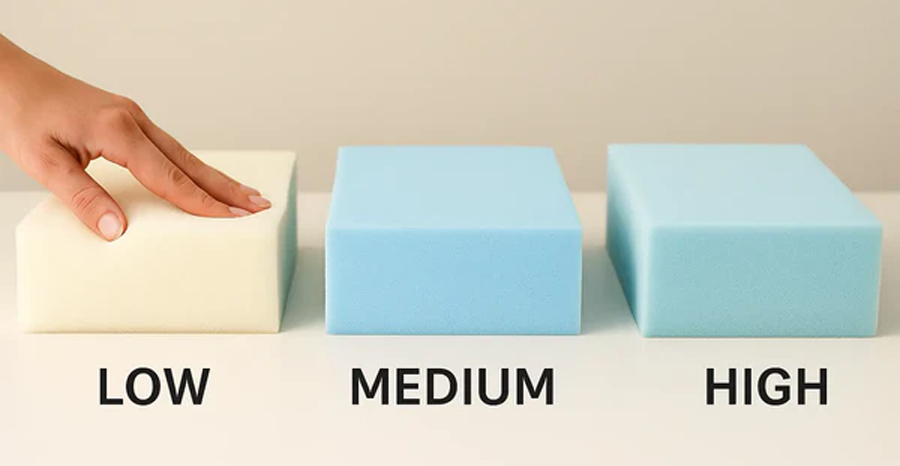
When evaluating foam products, making an informed purchasing decision requires more than comparing specifications. One of the most important performance indicators is foam density, but its value is best understood within the context of the available density range. A density figure alone provides only limited information. Without understanding where it falls within the spectrum of foam grades, it can be difficult to determine whether a material will provide the durability, support, and service life required for a specific application.
Foam density is the weight of a one-cubic-foot block of foam, typically expressed in pounds per cubic foot (PCF). For example, a foam with a density of 2.8 lb/ft³weighs 2.8 pounds for every 12"×12"×12"section of material. This measurement indicates how much material is contained within a given volume, making it a key factor in evaluating overall foam quality and durability.
In general, higher-density foams contain more material and tend to offer greater resistance to wear, compression, and long-term performance loss. As a result, they often maintain their structural integrity and comfort characteristics longer than lower-density alternatives.
It is important to note that density is not the same as firmness. Density measures the amount of material in the foam, while firmness—commonly measured by Indentation Load Deflection (ILD) or Indentation Force Deflection (IFD)—indicates how the foam feels when compressed. A foam can be soft yet high-density, or firm yet low-density. Understanding this distinction helps buyers accurately assess foam performance and avoid confusing comfort level with material quality.
A foam density rating such as 2.8 lb/ft³ is generally considered high-density within the range of conventional open-cell polyurethane foams, offering excellent durability, resilience, and long-term performance. However, the significance of this value becomes much clearer when it is evaluated alongside other density options, such as 1.2 lb/ft³or1.8 lb/ft³. While the numerical differences may seem small, the resulting differences in durability, support, and lifespan can be substantial.
Density values are most meaningful when viewed within the broader spectrum of available foam grades. Without this context, it can be difficult to determine whether a particular foam is suitable for the intended application or how it compares to alternative materials.
For this reason, foam products are often grouped into general density categories—such as economy, mid-grade, and high-performance—to simplify comparisons and help buyers make informed decisions. Understanding where a foam falls within these categories provides a practical benchmark for evaluating quality, expected longevity, and overall value.
Foams with densities ranging from 0.8 to 1.5lb/ft³are generally classified as fair-quality or low-density materials. Because they contain less material per unit volume, these foams tend to compress more easily and are more susceptible to wear under repeated use. As a result, they typically experience a faster loss of support and performance compared to higher-density alternatives.
While low-density foams are not intended for demanding, long-term applications, they offer significant advantages in terms of affordability and material efficiency. When used in the appropriate environment, they can provide reliable performance at a lower cost.
Packaging is a common application for this density range, where the foam's primary function is to cushion and protect products during handling and transportation. Low-density foams are also suitable for light-use comfort applications, such as guest-room mattress toppers, temporary bedding, and decorative cushioning. In these situations, where the foam is not subjected to continuous daily use, it can deliver satisfactory comfort and service life while remaining a cost-effective solution.
Foams with densities between 1.6and2.4 lb/ft³are generally considered good-quality, medium-density materials. This range offers an effective balance of durability, comfort, and cost, making it one of the most widely used categories across residential, commercial, and industrial applications.
While the numerical difference between densities such as 1.2 lb/ft³and1.8 lb/ft³may appear modest, the resulting improvement in performance can be substantial. Medium-density foams contain more material, providing greater resistance to compression, improved structural integrity, and better retention of their original shape over time. These characteristics make them well suited for everyday-use products, including furniture cushions, seating, mattresses, and upholstered components.
Performance generally increases as density rises within this category. Foams at the upper end of the range typically offer enhanced resilience, support retention, and service life compared to lower-density alternatives. For this reason, medium-density foams are often selected when a balance of long-term performance and cost efficiency is required.
Although some manufacturers and retailers may market 1.8 lb/ft³foam as premium or high quality, it is more accurately viewed as a reliable mid-range material. It delivers dependable performance for regular use but does not provide the same level of durability and longevity as high-density foams designed for demanding or long-term applications.
Foams with densities ranging from 2.5 to 3.5 lb/ft³are generally classified as high-quality, high-density materials. Representing the upper end of the conventional open-cell foam spectrum, these foams contain substantially more material per unit volume than lower-density alternatives. This increased material content contributes to superior durability, resilience, and long-term performance.
High-density foams are engineered for applications that demand consistent support and extended service life. Their enhanced structural integrity allows them to withstand repeated compression while maintaining their original shape and performance characteristics. As a result, they are commonly used in premium mattresses, high-performance seating, commercial furniture, and other products subjected to frequent or prolonged use.
Compared to lower-density foams, high-density materials are better able to resist sagging, softening, and permanent compression over time. This helps preserve comfort, support, and overall product performance throughout the life of the application.
Although high-density foam typically carries a higher initial cost, its extended durability often results in a lower total cost of ownership. For applications where longevity, reliability, and sustained performance are critical, high-density foam is frequently the most cost-effective choice over the long term.
One of the most overlooked aspects of foam selection is the impact that seemingly small density variations can have on overall performance. Differences of just 0.1 to 0.5 lb/ft³can affect durability, support retention, resilience, and resistance to long-term compression. While these changes may appear minor on paper, they can produce noticeable differences in how a foam performs throughout its service life.
Because conventional open-cell foams typically fall within a relatively narrow density range, even incremental increases in density can represent a meaningful increase in material content and performance potential. Understanding where a specific density falls within the broader spectrum allows for more accurate product comparisons and better-informed purchasing decisions.
Selecting the appropriate foam density begins with understanding the demands of the intended application. Lower-density foams are often a practical and economical choice for packaging, temporary cushioning, and other light-duty uses. Medium-density foams provide a balance of comfort, durability, and value, making them suitable for many everyday seating and bedding applications. High-density foams are designed for environments where long-term performance, support retention, and durability are critical.
Rather than viewing density as a standalone specification, it should be evaluated as part of a broader performance scale. Comparing density values within the context of the entire range helps clarify the expected durability, comfort, and lifespan of a foam product. By understanding these relationships, buyers can select materials that not only meet budget requirements but also deliver the level of performance needed for the application over time.


