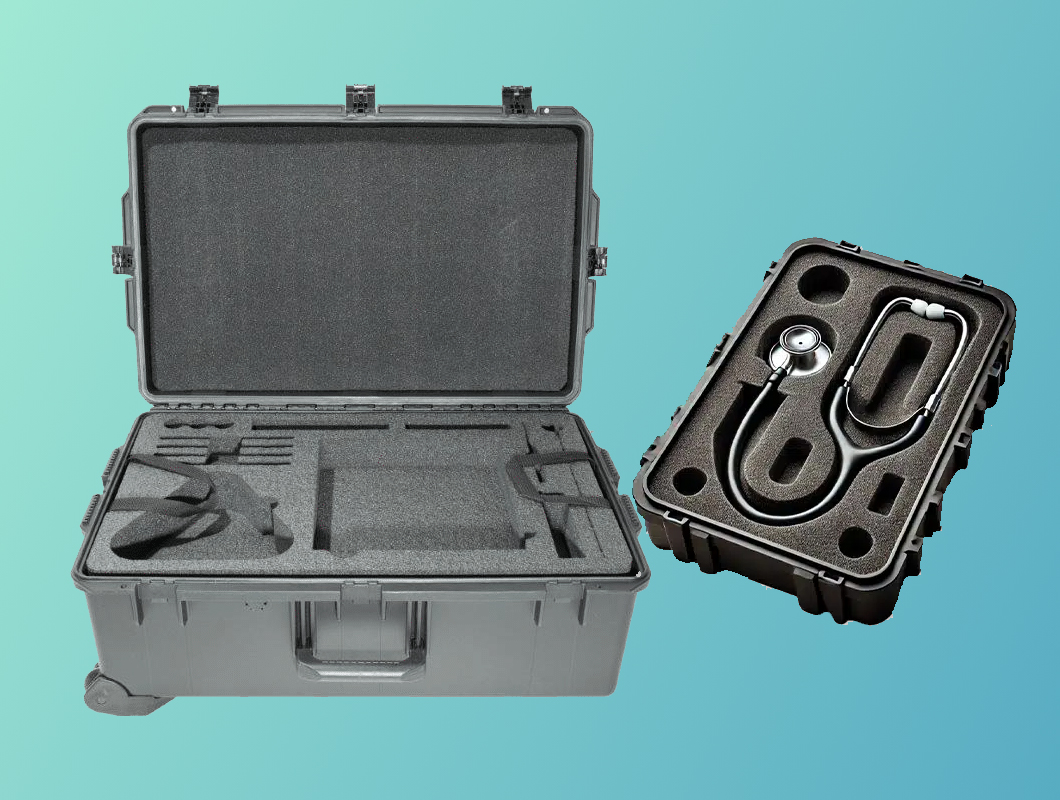
The right medical foam must provide patient comfort, protect delicate devices, and withstand the demanding conditions of clinical environments. Choosing the best material involves balancing several key factors, including density, compression resistance, memory retention, antimicrobial performance, washability, and fabrication accuracy. Together, these characteristics determine how well a foam solution performs throughout its service life.
Medical Device and Pharmaceutical Packaging
Foam packaging used in medical devices and pharmaceutical applications serves two critical purposes: protecting sensitive equipment during transportation and insulating temperature-sensitive medications from environmental changes. Achieving both requires careful material selection.
Expanded polyethylene foam (EPE) is widely used for medical device packaging because of its closed-cell structure, which offers excellent cushioning, shock absorption, and moisture resistance. EPE can be engineered to meet different cushioning requirements based on product weight and fragility, while its smooth Class A surface helps prevent scratches and abrasion on sensitive equipment.
Polyethylene foam (PE) is ideal for applications requiring strong chemical resistance and moisture protection across various density levels. PE resists hydrolysis, mold, and mildew growth, and is available in anti-static and fire-retardant grades for applications that demand multiple performance benefits in addition to cushioning.
Polyurethane foam (PU) is commonly selected for packaging complex or irregularly shaped medical devices. Its flexible structure conforms closely to product geometry, evenly distributes pressure, and can be fabricated into precision inserts using CNC routing or waterjet cutting. In applications requiring both structural stability and surface protection, layered combinations of EPE and PU foams provide an effective solution.
Expanded polypropylene foam (EPP) is frequently used for reusable medical packaging systems. Known for its high impact resistance and excellent shape recovery, EPP performs well in returnable transport packaging and other reusable shipping applications where durability through repeated handling cycles is essential.
Medical Cushioning
Foam used in hospital mattresses, bed cushions, lumbar supports, backrests, and wheelchair wedges must provide reliable support, relieve pressure, resist fungal growth, and maintain performance through repeated cleaning and daily use. Because each medical application places unique demands on the material, selecting foam based on density alone is rarely sufficient.
The ideal medical cushioning foam supports weight without bottoming out, resists moisture during repeated sanitation cycles, and maintains its shape and performance throughout the product's service life.
Three main categories of ether polyurethane (PU) foam are commonly used in medical cushioning applications, each offering distinct compression and recovery characteristics.
Standard ether PU foam is widely used in hospital mattresses, cots, beds, and general support products. Its broad IFD range allows manufacturers to tailor firmness and comfort levels to patient needs. Ether PU is especially valued for its excellent hydrolytic stability, helping it resist moisture and withstand frequent cleaning.
Viscoelastic foam, often referred to as memory foam, is engineered for superior pressure relief and even pressure distribution. Its slow compression and recovery properties allow it to conform closely to patient anatomy, reducing pressure points during prolonged contact. This makes it ideal for applications where pressure management is clinically important.
High-resilience (HR) foam is designed for applications requiring long-term structural support. Unlike viscoelastic foam, HR foam rebounds quickly after compression and resists compression set during continuous use. This makes it well suited for wheelchair wedges, lumbar supports, and specialized backrests that must maintain their shape and support performance over time.
Many medical cushioning products incorporate multi-layer foam constructions. For example, a wheelchair cushion may combine an HR foam base for structural stability with a viscoelastic top layer for enhanced comfort and pressure distribution. Multi-layer fabrication also supports complex geometries, custom inserts, and both low- and high-volume production requirements.
Support Braces, Orthotics, and Prosthetics
Foam materials used in braces, orthotics, and prosthetics must provide comfort against the skin, durability during daily wear, washability, and the precision required for therapeutic effectiveness. Properly fabricated foam components help ensure accurate fit, consistent support, and reliable corrective performance.
Neoprene is a leading material for support braces because of its closed-cell structure, moisture resistance, and flexibility. It conforms comfortably to the body while maintaining consistent compression and support. Neoprene also performs well across a wide temperature range and offers excellent durability and tear resistance, making it suitable for knee braces, lumbar supports, and other orthopedic applications.
Cross-linked polyethylene (XLPE) foam is commonly used in rigid orthotic components such as custom heel lifts and precision inserts. Its uniform cell structure and dimensional stability allow for tighter tolerances and improved resistance to deformation under long-term load. Irradiation cross-linked XLPE also offers low off-gassing properties and a clean surface, which are important in direct-contact medical applications.
Expanded polyethylene (EPE) foam is used in orthotic and prosthetic applications that require lightweight cushioning combined with a smooth Class A surface. Its durability and repetitive impact resistance make it suitable for applications where both protection and low weight are essential.
TOPSUN supports the prosthetics and orthotics industry with custom foam fabrication solutions tailored to complex medical products. Many of these applications require multiple foam materials, layered constructions, and precision fabrication techniques. Both rapid prototyping and full-scale production are available to support development programs, specialized short runs, and long-term manufacturing needs.
Selecting the Right Medical Foam for Healthcare Applications
Choosing the right medical foam requires evaluating both density and IFD (Indentation Force Deflection) together. Density measures the amount of foam material within a cubic foot, while IFD indicates the amount of force needed to compress the foam by 25 percent. A foam may have high density with a soft feel, or lower density with greater firmness, so relying on only one measurement can lead to inconsistent performance.
Compression and recovery characteristics also play a critical role in patient comfort and therapeutic effectiveness. Viscoelastic foams compress and recover slowly, allowing them to conform closely to the body for enhanced pressure relief. High-resilience (HR) foams recover quickly and provide excellent resistance to compression set, making them ideal for long-term support applications. Standard ether polyurethane foam offers a balanced performance profile between these two options. Selecting the right foam depends on matching these characteristics to the clinical requirements of the application.
Antimicrobial performance is another important consideration in patient-contact environments. Foams that retain moisture or encourage microbial growth can increase the risk of contamination and infection. Factors such as material composition, cell structure, and surface treatments all contribute to the foam's resistance to moisture, bacteria, mold, and mildew.
Precision fabrication is equally important in medical applications. Components such as braces, orthotic inserts, and cushioning systems must maintain exact dimensions to ensure proper fit, support, and therapeutic consistency. Complex foam assemblies, layered constructions, and specialty inserts require accurate fabrication methods to achieve reliable results. Full-service manufacturing capabilities may also include cover application and private labeling completed in-house.
At TOPSUN, every healthcare project begins with a detailed evaluation of the product's functional and performance requirements. With more than 45 years of foam fabrication experience and manufacturing facilities in Minnesota and Colorado, TOPSUN develops custom foam solutions for applications ranging from single prototype components to large-scale production programs.
Contact TOPSUN Foam to discuss your medical or healthcare foam application.

 English
 العربية
 Français
 Русский
 Español
 Português
 Deutsch
 italiano
 日本語
日本語 한국어
한국어 Nederlands
 Tiếng Việt
 ไทย
ไทย Polski
 Türkçe
 ភាសាខ្មែរ
 Bahasa Melayu
 ဗမာစာ
ဗမာစာ தமிழ்
தமிழ் Filipino
 Bahasa Indonesia
 magyar
 Română
 Čeština
 қазақ
қазақ Српски
 हिन्दी
 فارسی
فارسی Kiswahili
 Norsk
Norsk Svenska
 українська
 Ελληνικά
 Suomi
Suomi עברית
עברית Latine
 Dansk
Dansk اردو
اردو বাংলা
বাংলা Afrikaans
 नेपाली
 Oʻzbekcha
 Azərbaycan dili
 Български
 guarani
 Hausa
Hausa Kurdî
Kurdî Kurdî
Kurdî Lietuvių
 Wikang Tagalog
 isiZulu


