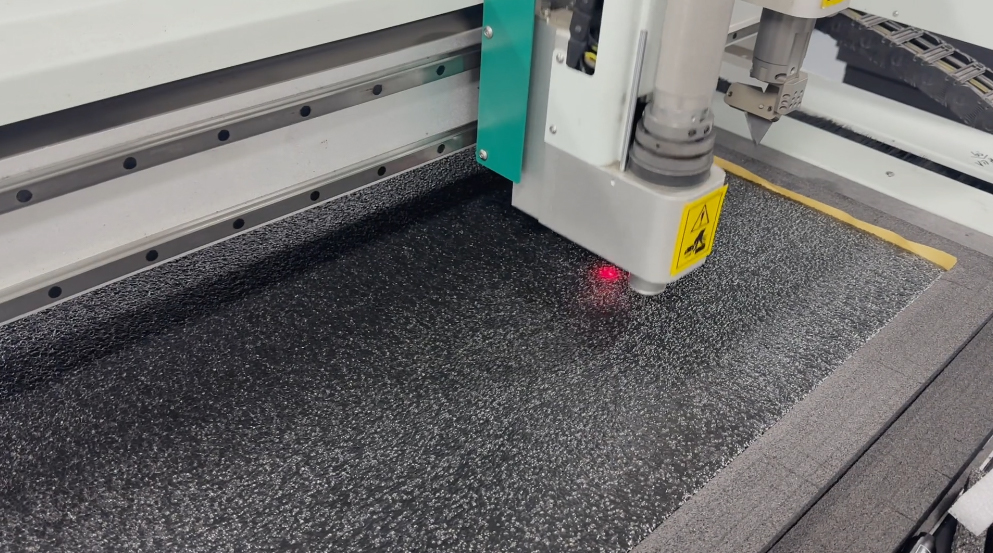
The expectations placed on foam fabricators are evolving rapidly. OEM engineers increasingly require custom foam solutions delivered faster, with tighter tolerances, reduced material waste, and greater support for sustainable materials. As these demands grow, manufacturers are turning to advanced fabrication technologies that improve precision, efficiency, and environmental responsibility.
Three key practices are driving this transformation: advanced waterjet cutting, precision CNC routing, and sustainable foam converting. Together, these innovations are reshaping the way custom foam components are designed and manufactured. At TOPSUN, we continue to invest in these capabilities to help customers meet the challenges of a changing industry.
1. Advanced Foam Waterjet Cutting
Waterjet cutting has long been a trusted fabrication method, valued for its versatility and accuracy. By using a high-pressure stream of water, the process cuts foam cleanly without generating heat, causing material deformation, or requiring specialized tooling. It is ideal for producing complex shapes across a wide variety of foam materials while eliminating the need for costly dies and avoiding thermal stress.
Today, however, waterjet technology is advancing beyond its traditional capabilities. Modern systems incorporate sophisticated digital controls, automation integration, and multi-axis cutting functionality, enabling fabricators to achieve greater precision and productivity than ever before. These improvements allow for tighter tolerances, more intricate geometries, and faster production cycles.
As cutting technology continues to evolve, manufacturers benefit from enhanced edge quality, improved consistency across thick cross-sections, and greater repeatability from part to part. While the technology advances, the fundamental advantages of waterjet cutting remain unchanged: cold cutting, exceptional accuracy, and tooling-free production.
2. Advanced CNC Routing for Complex Foam Components
For years, CNC routing has been the preferred solution for producing multi-depth cavities, tight-tolerance inserts, and intricate packaging geometries. Today, the technology continues to evolve, not only through greater machining precision but also through its integration into comprehensive foam converting workflows supported by advanced digital design tools.
Leading foam fabricators no longer view CNC routing as a standalone process. Instead, it functions as part of a coordinated manufacturing strategy that may include waterjet cutting, die cutting, contour cutting, skiving, and lamination. By selecting and sequencing these processes according to the geometry, production volume, and performance requirements of each project, manufacturers can achieve higher efficiency, improved quality, and more cost-effective production.
At the center of this approach are CAD-driven design systems and 3D modeling technologies. These tools enable engineers to validate fit, function, and dimensional accuracy before production begins, reducing risk and streamlining development. The result is fewer design revisions, more accurate first articles, and components engineered to perform as intended throughout their lifecycle. In modern foam fabrication, dimensional accuracy is only the starting point—the goal is optimized performance, usability, and presentation.
How TOPSUN Leverages CNC Routing
TOPSUN integrates CNC routing into a full-service foam converting operation, allowing customers to benefit from a flexible and highly engineered manufacturing approach.
Key advantages include:
●Integrated fabrication processes: CNC routing is combined with waterjet cutting, die cutting, contour cutting, skiving, and lamination to determine the most effective production method for each application.
●Precision-engineered component designs: For complex kits, custom foam inserts, and multi-layer packaging assemblies, CNC routing creates highly accurate patterns tailored to product protection, organization, and assembly requirements.
●Comprehensive prototype-to-production support: From initial prototypes and design refinements to nesting optimization and full-scale manufacturing, Amcon manages every stage of the project lifecycle.
●CAD-driven precision: Advanced CAD layouts and 3D modeling verify cavity depths, component placement, tolerances, and overall fit before production is scaled.
●Broad material compatibility: TOPSUN's CNC routing capabilities support a wide range of materials, including polyethylene (PE), cross-linked polyethylene (XLPE), polyurethane (PU), expanded polyethylene (EPE), expanded polypropylene (EPP), and other specialty foams. Material selection is guided by factors such as load requirements, durability, shock absorption, and product presentation objectives.
By combining advanced CNC routing technology with integrated converting expertise, TOPSUN delivers foam components that are not only dimensionally precise but also optimized for real-world performance, protection, and efficiency.
3. Sustainable Foam Converting
Sustainability has become a critical consideration in foam fabrication. What was once viewed as a secondary specification is now a key factor in material selection and product development. Increasing regulatory requirements, corporate sustainability initiatives, and evolving customer expectations are driving manufacturers to evaluate foam materials not only for performance, but also for their environmental impact.
As a result, the foam industry is embracing more sustainable solutions. According to Foam Expo North America, manufacturers are accelerating the adoption of closed-loop recycling systems, chemically recycled polyurethane materials, and bio-based foam formulations. At the same time, growing regulatory scrutiny of PFAS and other legacy chemicals is encouraging the development and use of safer, more environmentally responsible alternatives.
Research from Archive Market Research suggests that customization will play a major role in the next phase of sustainable material development. Rather than adapting standard materials to specialized applications, manufacturers are increasingly collaborating with end users to create bio-based and recycled-content foam solutions engineered for specific performance requirements. This approach enables organizations to meet sustainability goals without compromising product protection, durability, or functionality.
TOPSUN's Approach to Sustainability
TOPSUN's commitment to sustainability extends beyond material selection and is embedded throughout our manufacturing and design processes. In recognition of these efforts, TOPSUN received the 2025 Pregis Purpose Award for reducing carbon emissions by 150 metric tons—an achievement that reflects our ongoing focus on environmental responsibility and operational efficiency.
Our sustainability strategy is guided by several core principles:
●Designing packaging solutions with the lowest practical mass and density required for performance.
●Prioritizing highly recyclable materials and products with the highest feasible recycled content.
●Operating internal recycling programs for post-production scrap and manufacturing waste.
●Engineering packaging for maximum protection while minimizing material consumption.
●Continuously improving manufacturing efficiency and process yields to reduce waste.
When bio-based or recycled-content foam materials can meet the mechanical, chemical, and dimensional requirements of an application, our engineering team actively evaluates and recommends them. However, material selection is always driven by performance requirements first. Sustainability is an important part of the decision-making process, ensuring customers receive solutions that balance environmental responsibility with reliable, long-term performance.
Staying Ahead of Industry Demands
At TOPSUN, we monitor emerging technologies and industry developments not simply to keep pace with change, but to ensure our customers have access to the most effective materials, processes, and manufacturing solutions for their unique applications.
Advancements in foam waterjet cutting, integrated CNC converting, and sustainable foam fabrication are more than industry trends—they deliver measurable benefits in precision, efficiency, material optimization, and overall cost performance. By continuously investing in these capabilities, TOPSUN helps manufacturers overcome evolving challenges while achieving higher-quality outcomes and greater long-term value.
As customer requirements become increasingly complex, our focus remains the same: providing the right material, the right process, and the right solution for every application.

 English
 العربية
 Français
 Русский
 Español
 Português
 Deutsch
 italiano
 日本語
日本語 한국어
한국어 Nederlands
 Tiếng Việt
 ไทย
ไทย Polski
 Türkçe
 ភាសាខ្មែរ
 Bahasa Melayu
 ဗမာစာ
ဗမာစာ தமிழ்
தமிழ் Filipino
 Bahasa Indonesia
 magyar
 Română
 Čeština
 қазақ
қазақ Српски
 हिन्दी
 فارسی
فارسی Kiswahili
 Norsk
Norsk Svenska
 українська
 Ελληνικά
 Suomi
Suomi עברית
עברית Latine
 Dansk
Dansk اردو
اردو বাংলা
বাংলা Afrikaans
 नेपाली
 Oʻzbekcha
 Azərbaycan dili
 Български
 guarani
 Hausa
Hausa Kurdî
Kurdî Kurdî
Kurdî Lietuvių
 Wikang Tagalog
 isiZulu


