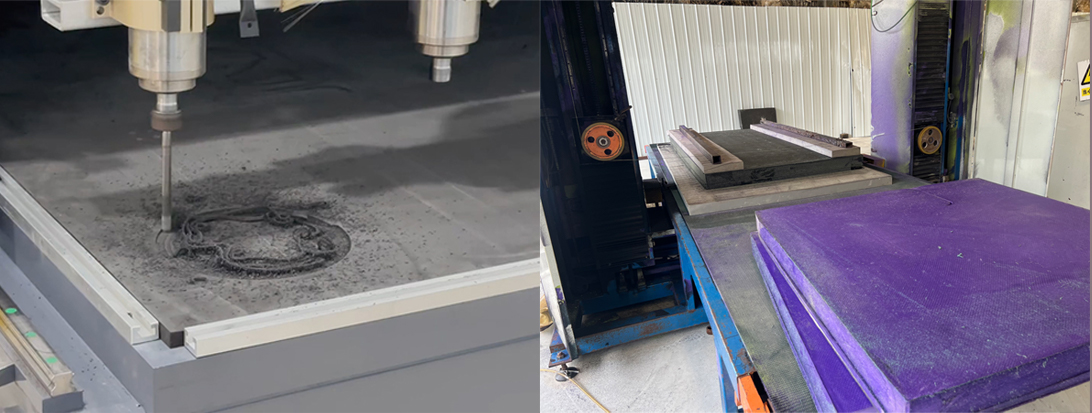
Die Cutting: Scalable, Consistent, and Cost-Effective Foam Fabrication
Die cutting is one of the most widely used and efficient methods for precision foam fabrication. It delivers exceptional consistency, repeatability, and production speed, making it the preferred solution for high-volume foam components across a wide range of industries.
By using a custom-made steel rule die, die cutting produces foam parts with precise dimensions, clean edges, and tight tolerances. Whether manufacturing industrial gaskets, protective packaging inserts, cushioning components, or specialized OEM parts, die cutting offers a reliable and economical solution for large-scale production.
How Die Cutting Works
The process begins with the creation of a custom steel rule die. A sharpened steel blade is formed to match the exact profile of the desired part and mounted into a die board. Foam sheets or rolls are then placed into a press, where controlled pressure is applied to cut the material into the required shape.
Once the die has been manufactured, production becomes highly efficient. Large quantities of identical parts can be produced quickly and accurately with minimal material waste.
Depending on material characteristics, part complexity, and production requirements, TOPSUN offers both:
●Flatbed Die Cutting – Ideal for thicker foam materials, intricate shapes, and lower-to-medium production volumes.
●Rotary Die Cutting – Best suited for thinner foam materials and high-speed, high-volume manufacturing applications.
Ideal Applications
Die cutting is commonly used to manufacture:
●Protective packaging inserts for tools, electronics, medical devices, and sensitive equipment.
●Custom gaskets and seals for industrial, HVAC, automotive, and electronic applications.
●Foam pads, spacers, and cushioning components for shock absorption and vibration control.
●Medical and orthopedic foam products.
●Acoustic and sound-dampening components for equipment enclosures and electronics.
●Retail packaging inserts that require a clean, professional presentation.
●Multi-layer laminated foam assemblies used in OEM and manufacturing applications.
Why Choose Die Cutting?
For high-volume production, die cutting remains one of the most cost-effective foam converting methods available. After the initial die is produced, parts can be manufactured rapidly with outstanding repeatability and low per-unit costs. As production volumes increase, the cost savings become even more significant.
This makes die cutting an excellent choice for production lines, contract packaging operations, kitting programs, and OEM component manufacturing where consistency and efficiency are critical.
TOPSUN provides comprehensive in-house die design, fabrication, and foam converting capabilities. Our advanced die-cutting equipment enables us to support everything from prototype runs and specialty packaging projects to large-scale production programs with reliable quality and fast turnaround times.
Compatible Foam Materials
Die cutting is compatible with a wide range of foam materials, including:
●Polyethylene (PE)
●Cross-Linked Polyethylene (XLPE)
●Polyurethane (PU)
●Expanded Polyethylene (EPE)
●Expanded Polypropylene (EPP)
Our team can help determine the most suitable material and cutting process based on your product requirements, performance specifications, and production volume.
Waterjet Cutting: Precision, Flexibility, and Clean Foam Processing
Waterjet cutting is a highly accurate foam fabrication method that uses an ultra-high-pressure stream of water to cut foam materials with exceptional precision. As a cold-cutting process, it generates no heat, applies no mechanical stress, and preserves the integrity of the material throughout production.
This technology is ideal for creating complex foam components, intricate designs, and custom packaging solutions while maintaining clean edges and tight tolerances.
How Waterjet Cutting Works
Waterjet cutting systems use a concentrated stream of water pressurized to as much as 60,000 psi and directed through a computer-controlled nozzle. Guided by CAD-generated designs, the waterjet precisely cuts foam sheets and blocks into virtually any shape, contour, cavity, or insert.
Because the process is non-abrasive and requires no physical cutting tools, it eliminates many of the limitations associated with traditional fabrication methods. Waterjet cutting produces smooth, accurate edges without overcutting, tearing, or material distortion.
Unlike laser cutting or some mechanical cutting methods, waterjet cutting is a true cold-cutting process. It does not generate heat that can melt, warp, harden, or chemically alter the foam. This makes it particularly well suited for thermally sensitive materials and applications where material performance must remain unchanged.
Another key advantage is the absence of dedicated tooling. Design modifications can be implemented quickly, making waterjet cutting an excellent solution for prototypes, short production runs, and projects requiring frequent design revisions.
Ideal Applications
Waterjet cutting is commonly used for:
●Low- to medium-volume production runs.
●Prototype development and product launches.
●Custom foam solutions requiring frequent design changes.
●Protective packaging inserts for electronics, medical devices, and sensitive equipment.
●Custom case interiors for tools, military equipment, and specialty gear.
●OEM foam components for automotive, industrial, and appliance applications.
●Medical-grade cushioning, positioning, and support products.
●Precision gaskets, seals, and spacers for demanding applications.
Why Choose Waterjet Cutting?
Waterjet cutting offers an unmatched combination of precision, material versatility, and design flexibility. With no tooling requirements and minimal material waste, it is an efficient solution for projects that demand intricate geometries, rapid design iterations, and superior edge quality.
The process is particularly valuable when part complexity, customization, or material sensitivity makes traditional die cutting or routing less suitable.
Compatible Foam Materials
Waterjet cutting is compatible with a wide range of foam materials, including:
●Polyethylene (PE)
●Cross-Linked Polyethylene (XLPE)
●Polyurethane (PU)
●Expanded Polyethylene (EPE)
●Expanded Polypropylene (EPP)
TOPSUN's Waterjet Cutting Capabilities
TOPSUN operates one of the region's most advanced waterjet cutting facilities, enabling us to deliver high-volume capacity while maintaining exceptional precision.
Our capabilities include:
●A specialized 5-axis waterjet cutting system — offering advanced multi-angle cutting capabilities
●More than 20 cutting heads — supporting high throughput and efficient production scheduling
With advanced equipment, experienced technicians, and extensive foam converting expertise, TOPSUN delivers precision-cut foam components for packaging, industrial, medical, and OEM applications with speed, accuracy, and consistency.
CNC Routing & Pattern Cutting: Precision Foam Fabrication for Complex Designs and Custom Inserts
CNC (Computer Numerical Control) routing is an advanced foam fabrication process that uses computer-guided cutting tools to produce highly detailed foam components with exceptional accuracy. It is the preferred solution for applications requiring complex geometries, multi-level cavities, tight tolerances, and custom-fit designs.
From premium packaging inserts and custom case interiors to engineered industrial components, CNC routing delivers precise, repeatable results while offering virtually unlimited design flexibility.
How CNC Routing & Pattern Cutting Works
CNC routing is a fully digital manufacturing process driven by CAD (Computer-Aided Design) files. Engineers create or import digital models that define every cut, contour, cavity, and profile required for the finished part.
Specialized software converts these designs into programmed toolpaths, which guide the cutting tools through foam sheets or blocks with precise control over speed, depth, and positioning. By moving along multiple axes, the CNC router can create intricate shapes, stepped pockets, recessed areas, and complex internal features that would be difficult or impossible to achieve with traditional cutting methods.
Pattern cutting extends these capabilities by arranging and machining repeated or custom layouts within the foam. This includes organized tool storage systems, multi-component packaging inserts, nested part configurations, and custom equipment protection solutions.
Because the entire process is digitally controlled, CNC routing offers outstanding consistency, repeatability, and dimensional accuracy across every production run.
Ideal Applications
CNC routing and pattern cutting are commonly used for:
●Custom case inserts and premium packaging for tools, electronics, instruments, and high-value products that require precise fit and professional presentation.
●Multi-component kits and kitting solutions for medical procedure trays, diagnostic kits, maintenance toolkits, and accessory sets.
●Prototypes and short-run production parts used for product development, testing, and validation.
●Tool organization systems, including drawer inserts, shadow boards, tool control panels, and field-service cases.
●OEM and industrial components such as spacers, supports, vibration-dampening elements, and interface components.
●Marine, transportation, and harsh-environment applications requiring flotation components, acoustic insulation, thermal barriers, and impact-resistant assemblies.
Why Choose CNC Routing?
CNC routing combines precision machining with exceptional design flexibility, making it ideal for projects that require detailed features, custom geometries, or highly engineered foam solutions.
Unlike processes that rely on dedicated tooling, CNC routing allows designs to be modified quickly and efficiently, reducing development time and enabling rapid prototyping. The ability to machine multiple depths and create intricate internal features also makes CNC routing one of the most versatile foam fabrication methods available.
For applications where appearance, fit, organization, and dimensional accuracy are critical, CNC routing provides a premium solution that consistently delivers professional results.
Compatible Foam Materials
CNC routing and pattern cutting are compatible with a wide range of foam materials, including:
●Polyethylene (PE)
●Cross-Linked Polyethylene (XLPE)
●Polyurethane (PU)
●Expanded Polyethylene (EPE)
●Expanded Polypropylene (EPP)
●Specialty and engineered foam materials
Whether creating custom packaging inserts, precision industrial components, or complex protective solutions, CNC routing enables TOPSUN to deliver foam products that meet demanding performance, aesthetic, and functional requirements.
Comparing Die Cutting, Waterjet Cutting, and CNC Routing
Selecting the right foam fabrication method depends on several factors, including part geometry, production volume, performance requirements, and whether tooling investment is justified for the project.
Each cutting technology offers distinct advantages:
●Die Cutting is the most cost-effective option for high-volume production of flat, repeatable parts. Once the tooling is created, production speeds are high and per-part costs decrease significantly as volume increases.
●Waterjet Cutting provides exceptional flexibility for low- to medium-volume production, prototypes, and complex designs without the need for dedicated tooling.
●CNC Routing excels at creating multi-level cavities, recessed features, and highly detailed foam inserts that require precise depth control and complex internal geometries.
In general, flat parts with consistent designs are best suited to die cutting, while custom or frequently changing designs benefit from the flexibility of waterjet cutting or CNC routing. For projects requiring intricate cavities and multiple depth levels, CNC routing is often the preferred solution. When complex exterior profiles, angled cuts, or full-thickness contours are required, waterjet cutting offers capabilities that traditional routing methods cannot easily achieve.
Waterjet Cutting and Thick Foam Materials
Waterjet cutting delivers outstanding accuracy across a wide range of foam materials and thicknesses. However, when cutting particularly thick foam sections, conventional 2-axis waterjet systems may produce slight edge taper due to the natural characteristics of the water stream as it passes through the material.
TOPSUN's advanced 5-axis waterjet technology compensates for this effect by automatically adjusting the cutting angle throughout the process. The result is cleaner edges, improved dimensional accuracy, and consistent cut quality through the full thickness of the material.
CNC Routing and Internal Corners
CNC routing provides exceptional dimensional accuracy and surface quality. However, because the process relies on rotating cutting tools, the diameter of the cutting bit determines the minimum achievable inside corner radius.
As a result, perfectly sharp 90-degree internal corners cannot be produced directly through standard CNC routing without additional secondary operations. For applications where sharp internal corners are critical, waterjet cutting is often the more suitable solution.
Partner with TOPSUN for Custom Foam Fabrication
TOPSUN's custom foam fabrication services are supported by ISO 9001-certified quality systems and a comprehensive range of converting capabilities, including:
●Contour Cutting
●Abrasive Wire Cutting
●Foam Skiving
●Foam Convoluting
●Lamination
Together, these processes enable us to provide complete foam converting solutions for packaging, industrial, medical, automotive, marine, and OEM applications.
Our engineering team works closely with customers during the design and development stages to identify the most effective manufacturing method for each project. By aligning material selection, fabrication technology, and production requirements early in the process, we help optimize performance, quality, and cost efficiency.
With more than 40 years of foam fabrication expertise, TOPSUN has the knowledge, equipment, and manufacturing capabilities to support projects ranging from prototypes and custom packaging solutions to high-volume production programs.
Contact TOPSUN
Whether you need precision die-cut components, complex waterjet-cut parts, or custom CNC-routed foam inserts, TOPSUN can help you determine the best solution for your application.
Contact our team today to discuss your project requirements and identify the ideal foam cutting method based on your part geometry, production volume, and performance objectives.

 English
 العربية
 Français
 Русский
 Español
 Português
 Deutsch
 italiano
 日本語
日本語 한국어
한국어 Nederlands
 Tiếng Việt
 ไทย
ไทย Polski
 Türkçe
 ភាសាខ្មែរ
 Bahasa Melayu
 ဗမာစာ
ဗမာစာ தமிழ்
தமிழ் Filipino
 Bahasa Indonesia
 magyar
 Română
 Čeština
 қазақ
қазақ Српски
 हिन्दी
 فارسی
فارسی Kiswahili
 Norsk
Norsk Svenska
 українська
 Ελληνικά
 Suomi
Suomi עברית
עברית Latine
 Dansk
Dansk اردو
اردو বাংলা
বাংলা Afrikaans
 नेपाली
 Oʻzbekcha
 Azərbaycan dili
 Български
 guarani
 Hausa
Hausa Kurdî
Kurdî Kurdî
Kurdî Lietuvių
 Wikang Tagalog
 isiZulu


