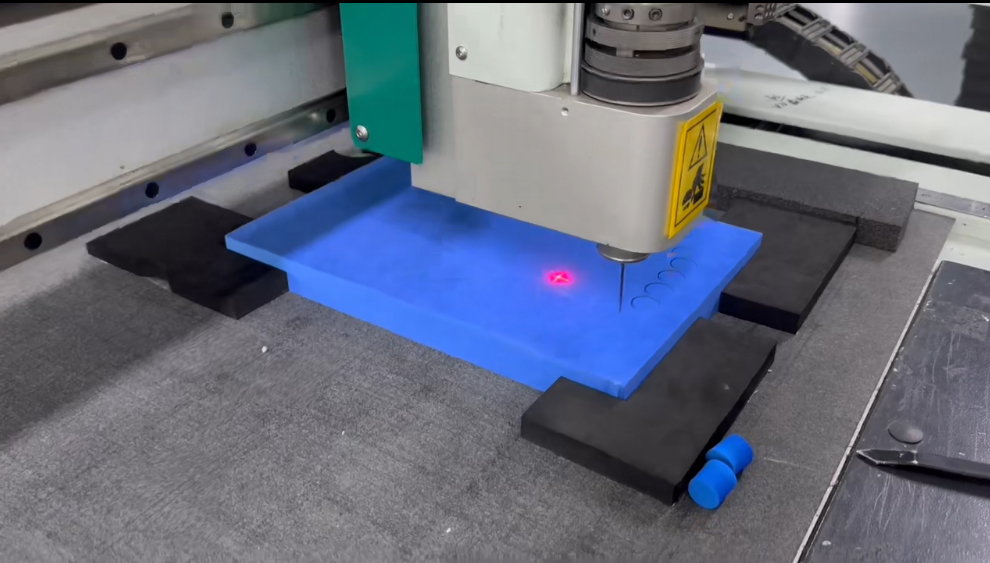
Inside TOPSUN's Approach to Custom Foam Fabrication
A digital design defines the shape and dimensions of a foam part, but it cannot fully predict how the material will cut, compress, or maintain tolerances during production. By bringing design and fabrication together under one roof, TOPSUN enables close collaboration across every stage of a project. Our engineering team considers material properties and manufacturing requirements early in the process, helping ensure that each design translates smoothly into production. Here's how our integrated approach delivers custom foam components that meet your specifications with precision and consistency.
Designing for Fabrication From the Start
Material selection is the foundation of every successful foam fabrication project. We begin by identifying options that meet your application requirements and budget. Our engineers then help evaluate material performance, refine the design, and develop prototypes to verify fit and function before moving into production.
Custom case inserts demonstrate how this process works. We start with the internal dimensions of your specific case model to determine the appropriate foam layers and cavity layouts. If needed, you can also bring your products to our facility, where we use 3D scanning technology to capture their exact geometry and incorporate it into the design.
Our objective is to use only the foam necessary to protect each product. By eliminating excess material, we can help reduce material costs and packaging weight without compromising protection.
Choosing the Right Material
With more than 80 foam classifications in our warehouse, TOPSUN offers a broad range of materials for different applications. Selecting the right foam requires understanding how it responds to compression, interacts with contact surfaces, and performs under actual operating conditions. Our team helps you evaluate these factors and make informed material decisions.
Expanded polypropylene (EPP) and expanded polyethylene (EPE) are two widely used options. EPP generally offers higher compressive strength and better resistance to deformation under load. EPE, meanwhile, provides a softer contact surface that helps protect Class A finishes, such as painted metal, making it a suitable choice for automotive components and other finished products.
Density is another important consideration. It refers to a foam's mass per unit volume, not its firmness or hardness. Since higher-density materials typically cost more, selecting the appropriate density helps avoid unnecessary material expenses while ensuring the foam delivers the performance your application requires.
Specialty Materials
Certain applications call for materials with more specialized performance characteristics. Cross-linked polyethylene (XLPE), for example, is a closed-cell foam known for its resistance to moisture, many chemicals, oils, and solvents. These properties make it a practical choice for gaskets, seals, and components exposed to demanding industrial conditions. Because XLPE typically costs more than non-cross-linked polyethylene, our team helps evaluate whether its added performance justifies the investment.
Color and appearance can also be important to a project. Some materials, including products from Zotefoams, are available in a variety of colors to complement your brand identity. For military ammunition cases, we can also fabricate high-density foam with a firm surface and exceptional rigidity to support demanding storage and protection requirements.
Matching the Fabrication Method to the Part
Fabrication begins with bringing the foam to the required thickness. Skiving removes material from the original foam stock to achieve the specified dimensions. When working with closed-cell foam, this process is commonly referred to as splitting; for open-cell foam, it is often called slitting.
Some designs require a combination of material properties, such as soft cushioning paired with firm structural support. Foam lamination makes this possible by bonding multiple foam layers or materials into a single sheet or component. The appropriate bonding method depends on the materials, part geometry, and production requirements:
●Smart Foam lamination: Uses controlled pressure to create consistent bonds across production batches.
●Robotic gluing: Applies adhesive with precision to shaped parts and complex multi-layer assemblies.
●Heated plank lamination: Uses heat and pressure rather than adhesive, making it suitable for thicker foam materials.
Selecting the Right Cutting Process
The best cutting method depends on production volume, dimensional tolerances, and part complexity. Our team evaluates these factors to identify the most efficient process for your design.
●Waterjet cutting: Ideal for intricate geometries and lower-volume projects, with no custom tooling required.
●Die cutting: Well suited to high-volume production of flat parts, where tooling costs can be offset by lower per-part costs.
●Contour cutting: Creates complex three-dimensional profiles, curves, and tapers with smooth, accurate edges.
●Abrasive wire cutting: Handles thick foam blocks, soft formulations, and specialty materials that may be difficult to process with conventional blades or heat-based methods.
●CNC routing and pattern cutting: Produces precise channels, recessed areas, and multi-depth cavities for custom foam components.
One Team From Design to Delivery
Packaging and shipping requirements are part of our planning from the very beginning. Depending on your needs, we can wrap finished components in plastic, package them in bulk bags or boxes, or prepare them for palletized shipment. Beyond fabrication, our team supports subassembly, kitting, and final assembly to help streamline your supply chain and simplify delivery.
Custom Foam Solutions, All Under One Roof
Every custom foam component must meet precise dimensional requirements, maintain consistent quality during production, and perform reliably in its intended application. At TOPSUN, engineering expertise and hands-on fabrication work together throughout the entire process, from initial design and prototyping to full-scale production.
By keeping these capabilities connected, we make it easier to move your project forward with fewer handoffs and a more coordinated approach.
Connect with the TOPSUN team to discuss a custom foam solution tailored to your application.

 English
 العربية
 Français
 Русский
 Español
 Português
 Deutsch
 italiano
 日本語
 한국어
 Nederlands
 Tiếng Việt
 ไทย
 Polski
 Türkçe
 ភាសាខ្មែរ
 Bahasa Melayu
 ဗမာစာ
 தமிழ்
 Filipino
 Bahasa Indonesia
 magyar
 Română
 Čeština
 қазақ
 Српски
 हिन्दी
 فارسی
 Kiswahili
 Norsk
 Svenska
 українська
 Ελληνικά
 Suomi
 עברית
 Latine
 Dansk
 اردو
 বাংলা
 Afrikaans
 नेपाली
 Oʻzbekcha
 Azərbaycan dili
 Български
 guarani
 Hausa
 Kurdî
 Kurdî
 Lietuvių
 Wikang Tagalog
 isiZulu


