Open Cell EPDM Foam Roll for Cushioning, Sound Absorption and Custom Gaskets
Topsun open cell EPDM foam roll is a soft, flexible and low-compression sponge rubber material designed for cushioning, vibration damping, sound absorption, gap filling, dust protection and custom foam components. It is widely used in automotive interiors, construction, electronics, appliances, manufacturing equipment and protective packaging.
EPDM rubber is known for excellent ageing, weathering, UV and ozone resistance. The open-cell structure provides a soft feel and low compression force, making the material suitable for applications where flexibility, conformability, cushioning and acoustic performance are more important than rigid sealing.
Topsun can supply open cell EPDM foam as rolls, sheets, strips, adhesive-backed tapes, pads, gaskets and custom die-cut parts. Density, thickness, dimensions, adhesive backing and converted shapes can be customized according to drawings, samples and application requirements.
Open Cell EPDM Foam Roll Features
Open-cell sponge rubber structure for soft compression and cushioning applications.
Soft to the touch and easy to compress under relatively low loads.
Good vibration damping and sound absorption performance.
Can be converted into rolls, sheets, strips, pads, tapes and custom gaskets.
Excellent ageing performance for long-term industrial applications.
Good weathering, UV and ozone resistance associated with EPDM rubber.
Multiple densities and thicknesses available for different compression requirements.
Available with or without pressure-sensitive adhesive backing.
Suitable for laser cutting, die cutting, slicing, lamination and other foam converting processes.
Open Cell EPDM Foam Technical Specification
The following test data covers several open cell EPDM foam density grades. Actual specifications can be selected according to the required compression, cushioning, sealing, acoustic and fabrication performance.
| EPDM Foam Technical Specification |
| TESTING ITEM | Test Method | Units | 70 | 90 | 120 |
| Test Standard | Test Result | Test Standard | Test Result | Test Standard | Test Result |
| Density | GB/T 6343-2009 | kg/m³ | 70±10 | 73.8 | 90±10 | 93.1 | 110±10 | 108.7 |
| Tensile Strength | GB/T 6344-2009 | KPa | ≥50 | 138 | ≥50 | 153 | ≥50 | 164.64 |
| Elongation | GB/T 6344-2009 | % | ≥100 | 173.32 | ≥100 | 166.4 | ≥100 | 177.49 |
| Compressive Strength 50% | ASTM D1056 | KPa | ≤5 | 2.21 | ≤5 | 2.69 | ≤5 | 2.91 |
| Compressive Strength 25% | ASTM D1056 | KPa | ≤5 | 1.25 | ≤5 | 1.88 | ≤5 | 1.97 |
| Compression Set | GB/T 6669-2008 | 50%/22h at 70℃ | ≤30 | 7.2 | ≤30 | 6.3 | ≤30 | 6.7 |
| Tear Strength | GB/T10808-2006 | N/m | ≥200 | 271 | ≥200 | 378 | ≥200 | 271 |
| Water Absorption | JISK6767 | % | 0.5-3.7 | 2.3 | ≤3 | 2.1 | ≤3 | 1.9 |
Open Cell EPDM Foam Video
Applications of Open Cell EPDM Foam Roll
Open cell EPDM foam is especially suitable for applications requiring soft compression, cushioning, vibration control, sound absorption and conformability to irregular surfaces.
Automotive interiors: anti-rattle pads, interior cushioning, vibration damping and acoustic components.
Electronics and appliances: protective pads, gap fillers, cushioning and vibration-control parts.
Construction: soft gap filling, joint cushioning and compression components.
HVAC and equipment: vibration damping, acoustic treatment and soft interface materials.
Manufacturing lines: equipment protection, assembly cushioning and anti-vibration components.
Packaging: impact protection, surface protection and reusable cushioning.
Converted foam products: full rolls, sheets, strip-cut lengths, pads, gaskets and adhesive-backed tapes.
For applications requiring a highly water-resistant or air-tight barrier, the required cell structure, density and compression should be confirmed before material selection. Closed-cell EPDM may be more appropriate for demanding environmental sealing applications.
What Is Open Cell EPDM Foam?
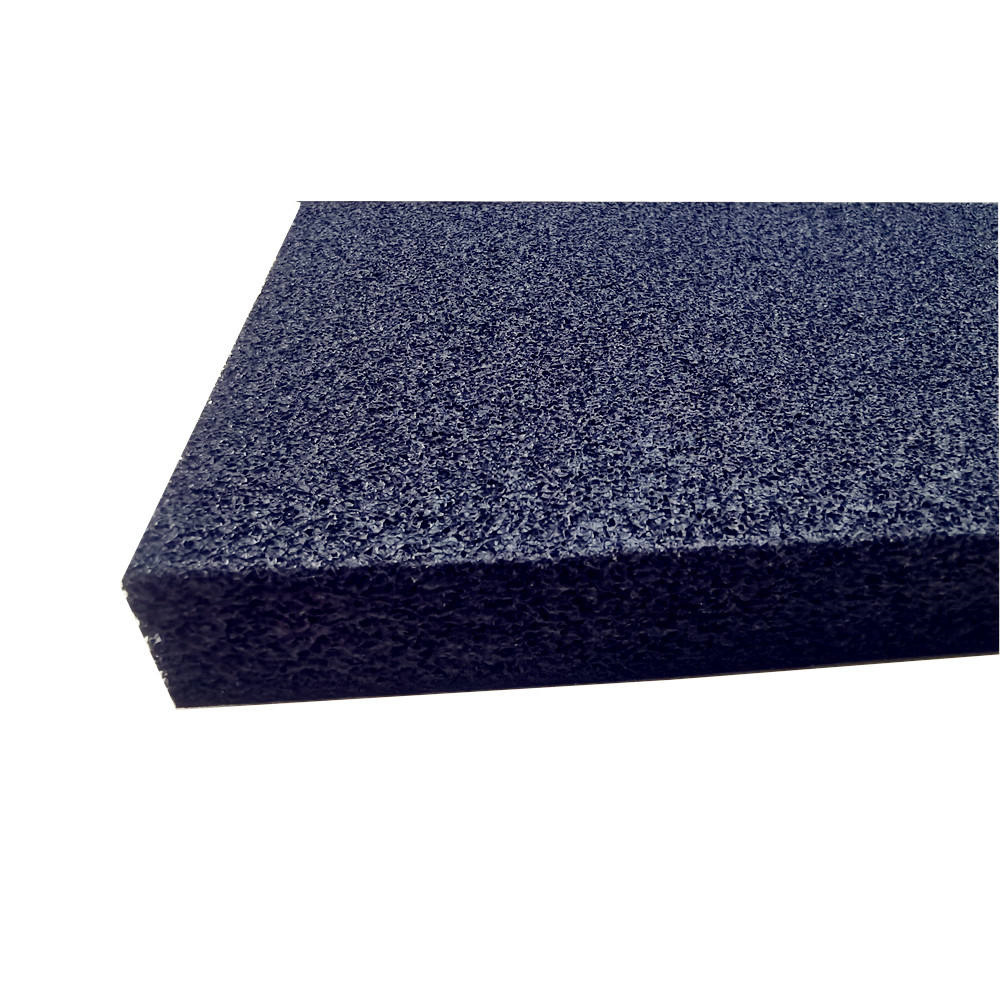
EPDM stands for Ethylene Propylene Diene Monomer. EPDM foam is a synthetic rubber sponge material valued for weather resistance, ageing resistance, flexibility and resistance to UV radiation and ozone.
In open cell EPDM foam, the internal cells are interconnected. This structure allows the material to compress easily and conform to irregular surfaces, providing a softer feel and lower compression load than many closed-cell foam materials.
These characteristics make open cell EPDM particularly useful for cushioning, sound absorption, vibration damping, gap filling, anti-rattle applications and soft compression components.
Topsun can convert EPDM foam into rolls, sheets, strips, adhesive-backed tapes, pads, blocks, gaskets and custom die-cut parts. Customers can provide drawings, samples, dimensions or application details for material selection and fabrication.
Open Cell EPDM Foam vs. Closed Cell EPDM Foam
Selecting the correct EPDM foam structure depends on what the finished component must achieve.
| Comparison | Open Cell EPDM Foam | Closed Cell EPDM Foam |
| Cell Structure | Interconnected cells | Independent sealed cells |
| Compression | Softer and easier to compress | Generally firmer |
| Typical Functions | Cushioning, sound absorption, vibration damping and gap filling | Environmental sealing, weather stripping and moisture resistance |
| Surface Conformability | Excellent for irregular surfaces and low compression loads | Suitable when stronger sealing pressure is acceptable |
| Typical Selection | Automotive interiors, electronics, acoustics and cushioning | Outdoor seals, weather seals and water-resistant gaskets |
Custom Open Cell EPDM Foam Roll, Sheet, Strip and Gasket Options
Topsun provides both standard foam materials and customized foam converting services for OEM manufacturers, industrial buyers, distributors and component suppliers.
Thickness: multiple thicknesses can be selected according to compression space and application requirements.
Density: different density grades are available for different softness and compression requirements.
Format: full rolls, sheets, strips, pads, blocks, tapes and gaskets.
Adhesive backing: pressure-sensitive adhesive and release liner can be applied for easier assembly.
Custom cutting: rectangular parts, shaped components and custom profiles can be produced according to drawings or samples.
Packaging: packaging method can be selected according to part size, shipping requirements and order quantity.
Topsun Foam Processing Capabilities
Topsun can convert foam raw materials into semi-finished and finished components according to customer drawings, dimensions, samples and assembly requirements.
Cutting: foam sheets, rolls and blocks can be cut to customer-specified dimensions.
Slicing: foam can be sliced to the required thickness.
Lamination: hot-melt film lamination, flame lamination and pressure-sensitive adhesive lamination are available.
Laser Cutting: customized foam shapes can be cut from drawings without opening tooling for suitable projects.
Die Cutting: tooling can be produced for efficient volume production of foam gaskets, pads, seals and custom parts.
Compression Molding: three-dimensional molded foam and foam composite components can be produced for applications requiring defined geometry.
Engraving: suitable for customized tool-box inserts and protective packaging inserts.
Silk-Screen Printing: logos, marks and patterns can be printed on selected foam surfaces.
Adhesive Backing: adhesive and release liners can be laminated to foam for tapes and self-adhesive components.
Foam Materials Available from Topsun
In addition to open cell EPDM foam, Topsun supplies EVA foam, PE foam, XPE foam, IXPE foam, CR foam, neoprene foam, SBR foam, NBR foam and micro-cell soft PVC foam. Materials can be supplied as sheets, rolls or customized converted foam components according to project requirements.
About Topsun Foam
Topsun is a professional foam material supplier and foam converting manufacturer serving customers that require standard foam materials as well as customized foam components. Our capabilities cover material supply, cutting, slicing, lamination, adhesive backing, laser cutting, die cutting, engraving and other foam fabrication processes.
Our facility is located in Changzhou City, Jiangsu Province, China, with convenient access to major export transportation and Shanghai Port.
Open Cell EPDM Foam FAQ
What is open cell EPDM foam?
Open cell EPDM foam is a flexible sponge rubber made from EPDM rubber with interconnected internal cells. Its structure allows the material to compress easily, making it suitable for cushioning, vibration damping, sound absorption, gap filling and low-compression components.
What is open cell EPDM foam used for?
Typical applications include automotive interior pads, electronics cushioning, appliance components, construction gap filling, HVAC vibration damping, acoustic components, manufacturing equipment protection, packaging and custom foam gaskets.
What is the difference between open cell and closed cell EPDM foam?
Open cell EPDM contains interconnected cells and is generally softer and easier to compress, making it useful for cushioning, acoustics and vibration damping. Closed cell EPDM contains sealed cells and is generally preferred when stronger resistance to air, moisture and environmental exposure is required.
Is open cell EPDM foam waterproof?
Open cell foam contains interconnected pores, so it should not automatically be treated as a waterproof barrier. If the application requires water-tight or air-tight sealing, please provide the sealing pressure, exposure conditions and required performance so that Topsun can recommend the appropriate EPDM foam structure and grade.
Is open cell EPDM foam suitable for outdoor applications?
EPDM rubber provides good ageing, UV, ozone and weathering resistance. However, suitability depends on whether the foam will be directly exposed to water, compression, chemicals, temperature changes or other environmental conditions. Application details should be confirmed before final material selection.
Can Topsun supply open cell EPDM foam with adhesive backing?
Yes. Topsun can laminate pressure-sensitive adhesive and release liner to open cell EPDM foam. Adhesive-backed foam can be supplied as rolls, strips, tapes, pads and custom die-cut components for easier assembly.
Can you manufacture custom EPDM foam gaskets and die-cut parts?
Yes. Topsun provides cutting, slicing, laser cutting, die cutting, lamination and adhesive-backing services. Customers can send CAD drawings, dimensions, physical samples or application information for custom foam gasket and component production.
How do I choose the right open cell EPDM foam density and thickness?
The correct grade depends on the compression gap, required softness, thickness, recovery, cushioning performance, acoustic requirement, installation method and service environment. Providing these details helps Topsun recommend a suitable density and thickness.
What information should I provide when requesting a quotation?
Please provide the required foam type, density if known, thickness, width and length, adhesive requirement, application, drawing or dimensions, estimated order quantity and any special performance requirements.
How can I get open cell EPDM foam samples?
Send your requirements to july@topsunfoam.com or submit an inquiry through the Topsun contact page. Please include thickness, density, size, adhesive requirement, intended application and estimated quantity so the sales team can evaluate the appropriate sample.

 English
 العربية
 Français
 Русский
 Español
 Português
 Deutsch
 italiano
 日本語
日本語 한국어
한국어 Nederlands
 Tiếng Việt
 ไทย
ไทย Polski
 Türkçe
 ភាសាខ្មែរ
 Bahasa Melayu
 ဗမာစာ
ဗမာစာ தமிழ்
தமிழ் Filipino
 Bahasa Indonesia
 magyar
 Română
 Čeština
 қазақ
қазақ Српски
 हिन्दी
 فارسی
فارسی Kiswahili
 Norsk
Norsk Svenska
 українська
 Ελληνικά
 Suomi
Suomi עברית
עברית Latine
 Dansk
Dansk اردو
اردو বাংলা
বাংলা Afrikaans
 नेपाली
 Oʻzbekcha
 Azərbaycan dili
 Български
 guarani
 Hausa
Hausa Kurdî
Kurdî Kurdî
Kurdî Lietuvių
 Wikang Tagalog
 isiZulu


