Closed Cell NBR/PVC Foam with One Side Adhesive for HVAC Insulation
Topsun closed cell NBR/PVC foam with one side adhesive is a flexible elastomeric foam material designed for thermal insulation, sealing, cushioning and vibration-control applications. A pre-applied adhesive layer on one side helps position the foam directly onto suitable prepared surfaces, making it practical for HVAC ducts, refrigeration equipment, panels and industrial assemblies.
The referenced NBR/PVC grade has a closed-cell structure, density of 50–90 kg/m³, thermal conductivity of 0.038 W/m·K and a water vapor resistance index of ≥7000. These properties make it suitable for applications where thermal insulation and resistance to moisture penetration are important.
Topsun also provides different thicknesses, widths and converted formats for project requirements. The broader NBR/PVC foam range includes widths from 1000–1800 mm and thicknesses mainly from 3–50 mm.
Closed Cell NBR/PVC Foam Product Features
Closed-cell structure: helps reduce moisture and water vapor penetration through the foam.
One side adhesive backing: supports easier positioning on suitable ducts, panels and equipment surfaces.
Low thermal conductivity: the referenced grade lists thermal conductivity of 0.038 W/m·K.
High water vapor resistance: the referenced grade lists a water vapor resistance index of ≥7000.
Flexible installation: foam can follow flat, curved and selected irregular surfaces.
Compression performance: suitable for insulation, cushioning and selected sealing applications.
Vibration damping: flexible foam can help reduce vibration at joints, panels, equipment and support interfaces.
Resistance to acid, fuel and oil: existing product information lists resistance to these exposures.
Custom converting: suitable foam can be cut, sliced, laminated, die-cut and converted according to drawings.
Closed Cell NBR/PVC Foam Product Information
| Item | Product Information |
| Material | NBR/PVC Rubber Foam |
| Cell Structure | Closed Cell |
| Adhesive Construction | One Side Adhesive |
| Referenced Grade Density | 50–90 kg/m³ |
| Broader Product Range Density | 50–150 kg/m³ |
| Width | 1000–1800 mm |
| Typical Roll Length | Approximately 10 m |
| Main Thickness Range | 3–50 mm |
| Main Color | Black; other colors can be evaluated according to requirements |
NBR/PVC Foam Technical Specification
The following technical data applies to the referenced closed-cell NBR/PVC foam grade shown in the existing product information. Final specifications should be confirmed according to the selected density, thickness and application.
| Property | Units | Value | Test Method |
| Density | kg/m³ | 50–90 | ASTM D 1667 |
| Compression Set, 25% | % | ≤20 | ASTM D 1056 |
| Compression Deflection | kPa | 30–35 | ASTM D 1056 |
| Tensile Strength | kPa | ≥100 | ASTM D 412 |
| Elongation | % | ≥100 | ASTM D 412 |
| Thermal Conductivity | W/m·K | 0.038 | ASTM C 534 |
| Water Vapor Resistance Index | µ | ≥7000 | DIN EN 12086 |
| Upper Use Limit |
| 110 |
|
| Lower Use Limit |
| 20 |
|
| Fire Performance |
| HF-1 | UL 94 |
| Cell Structure |
| Closed Cell |
|
Note: the existing source table does not state units for the upper and lower use-limit values. Confirm the service-temperature range for the selected production grade before application.
Closed Cell NBR/PVC Foam Product Video
What Is Closed Cell NBR/PVC Foam with One Side Adhesive?
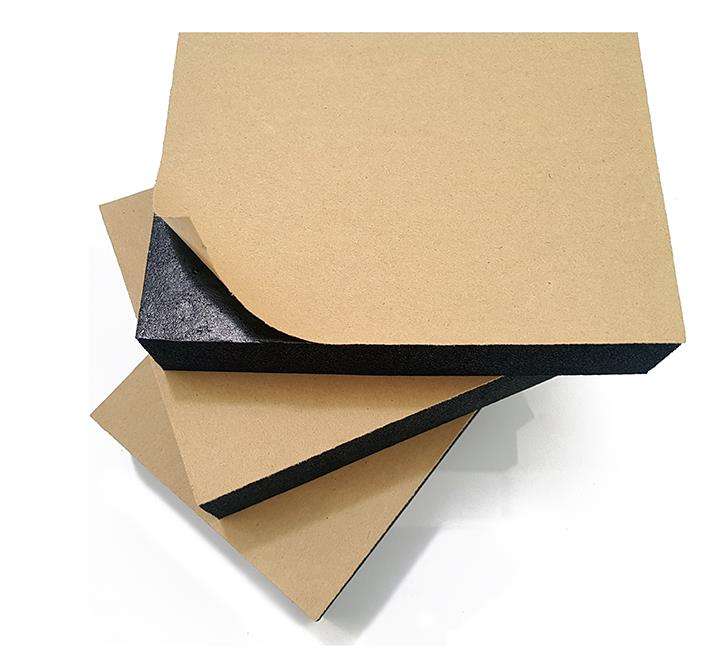
Closed cell NBR/PVC foam is a flexible cellular material made from a nitrile rubber and PVC foam system. The closed-cell structure helps limit moisture penetration while providing thermal insulation, cushioning and vibration-control properties.
One side of the foam is supplied with adhesive backing so that the material can be positioned directly onto a suitable prepared substrate. This can simplify installation on large duct surfaces, panels, equipment housings and other applications where applying adhesive separately would add an extra installation step.
The unbonded side remains the foam surface, while the adhesive side is used to attach the material to the intended substrate. The surface condition, temperature and installation environment should be considered when selecting an adhesive-backed construction.
One Side Adhesive NBR/PVC Foam for HVAC Duct Insulation
Large HVAC ducts are one of the main applications for self-adhesive closed-cell rubber foam sheets and rolls. The adhesive backing helps installers position the foam directly onto suitable prepared metal surfaces.
Closed-cell NBR/PVC foam provides thermal insulation while helping limit water vapor penetration. This combination is important in air-conditioning systems where duct surface temperature may differ significantly from the surrounding ambient temperature.
The flexible foam can be cut to fit around corners, transitions and selected irregular duct geometry. Final insulation thickness should be selected according to operating temperature, ambient temperature, humidity and condensation-control requirements.
Closed Cell NBR/PVC Foam for Refrigeration and Chilled-Water Systems
Closed-cell NBR/PVC foam can also be used in refrigeration, chilled-water and low-temperature equipment applications where both thermal performance and resistance to moisture penetration are required.
The referenced material has thermal conductivity of 0.038 W/m·K and a water vapor resistance index of ≥7000. These properties support the use of the foam in suitable thermal-insulation systems.
Proper treatment of joints, seams, edges and penetrations remains important because the performance of an insulation system depends on both the foam material and the quality of the complete installation.
Why Use One Side Adhesive Instead of Plain NBR/PVC Foam?
| Comparison | One Side Adhesive Foam | Plain Foam |
| Installation | Pre-applied adhesive assists positioning on suitable surfaces | Separate fixing or adhesive method may be required |
| Large Flat Surfaces | Suitable for ducts, panels and equipment surfaces | Requires separate installation method |
| Positioning During Assembly | Adhesive can help hold the material in position | Additional fixing may be required |
| Foam Performance | Based on the selected NBR/PVC foam grade | Based on the selected NBR/PVC foam grade |
One Side Adhesive vs. Double Side Adhesive NBR/PVC Foam
| Adhesive Type | Typical Function |
| One Side Adhesive | Attaches one foam surface to a duct, panel, equipment housing or other suitable substrate while leaving the opposite foam face exposed. |
| Double Side Adhesive | Used where the foam needs to be positioned between two suitable surfaces or incorporated into a layered assembly. |
For this product page, the main construction is closed-cell NBR/PVC foam with adhesive on one side.
Closed Cell Structure for Moisture and Condensation Control
Closed-cell foam contains predominantly isolated cells rather than an interconnected pore network. This structure helps reduce the movement of air and water vapor through the foam body.
For HVAC and refrigeration applications, moisture control is particularly important because condensation can occur when an insulated surface operates below the dew point of the surrounding air.
The referenced grade lists a water vapor resistance index of ≥7000. The performance of the complete system also depends on foam thickness, seam treatment, installation quality and environmental conditions.
Thermal Insulation Performance
The referenced closed-cell NBR/PVC foam grade lists thermal conductivity of 0.038 W/m·K according to ASTM C 534.
Low thermal conductivity helps reduce heat transfer between the insulated surface and the surrounding environment. This supports temperature control in HVAC, refrigeration and equipment applications.
Required insulation thickness should be calculated according to the system temperature, ambient conditions, humidity and project design rather than thermal conductivity alone.
Typical Applications
| Application | Typical Function |
| HVAC Ducts | Thermal insulation and easier installation on suitable duct surfaces. |
| Air Handling Equipment | Insulation, cushioning and vibration-control layers on suitable panels. |
| Refrigeration Equipment | Cold insulation and moisture-resistant foam covering. |
| Chilled-Water Systems | Thermal insulation and condensation-control support. |
| Equipment Panels | Adhesive-backed insulation, cushioning and vibration damping. |
| Industrial Housings | Thermal insulation, spacing and suitable sealing applications. |
| Automotive Components | Selected insulation, cushioning and vibration-control components. |
| Custom Foam Parts | Adhesive-backed strips, pads, gaskets and die-cut shapes. |
Surface Preparation for One Side Adhesive Foam
Adhesive performance depends on the surface to which the foam is applied. The substrate should be suitable for the selected adhesive construction and should be prepared according to the installation requirements.
Dust, oil, moisture and surface contamination can interfere with adhesive contact. The installation surface and operating environment should therefore be provided when discussing a custom adhesive-backed NBR/PVC foam product.
Where the foam is used in a critical insulation or sealing system, final adhesion and installation performance should be evaluated under the actual project conditions.
How to Select Closed Cell NBR/PVC Foam with One Side Adhesive
Application: HVAC duct, refrigeration equipment, chilled-water system, equipment panel or custom component.
Density: specify the required density or compression characteristics where known.
Thickness: select according to insulation, sealing or cushioning requirements.
Width and length: provide required sheet or roll dimensions.
Bonding surface: identify metal, plastic, panel or other substrate material.
Surface condition: identify coating, texture or other factors that may affect adhesion.
Operating temperature: provide the minimum and maximum service conditions.
Ambient conditions: provide humidity or condensation conditions where relevant.
Finished format: sheet, roll, strip, pad, gasket or custom die-cut part.
Estimated quantity: provide sample, trial and production quantities where available.
Custom NBR/PVC Foam Processing
Topsun provides NBR/PVC foam supply together with custom processing according to customer dimensions, drawings and finished component requirements.
1. Cutting: foam sheets and rolls can be cut according to customer dimensions.
2. Slicing: foam material can be sliced to the required thickness for suitable applications.
3. Lamination: hot-melt film lamination, flame lamination and pressure-sensitive adhesive lamination are available.
4. Laser Cutting: suitable foam components can be cut according to digital drawings.
5. Die Cutting: strips, pads, gaskets and other repeatable foam parts can be produced according to project designs.
6. Compression Molding: three-dimensional molded foam and foam composite components can be manufactured for suitable applications.
7. Engraving: suitable for tool-box inserts, packaging inserts and other custom foam components.
8. Silk-Screen Printing: logos and patterns can be printed on suitable foam surfaces.
9. Adhesive Backing: adhesive and release liner can be applied to suitable foam materials for adhesive-backed sheets, rolls, strips, pads and custom parts.
Other Foam Materials Available from Topsun
Topsun supplies NBR/PVC foam, NBR foam, EVA foam, PE foam, XPE foam, IXPE foam, CR foam, EPDM foam, neoprene foam, SBR foam and micro-cell soft PVC foam in sheet, roll and customized converted forms.
About Topsun Foam
Topsun supplies foam materials and custom foam components for HVAC, refrigeration, automotive, construction and industrial buyers. Customers can provide density, thickness, dimensions, bonding substrate and application information for product evaluation.
Our facility is located in Changzhou City, Jiangsu Province, China, with convenient access to Shanghai Port for international shipments.
Closed Cell NBR/PVC Foam with One Side Adhesive FAQ
What is closed cell NBR/PVC foam with one side adhesive?
It is flexible closed-cell NBR/PVC foam with adhesive backing applied to one side. The foam provides thermal insulation, cushioning and moisture-resistant properties, while the adhesive side helps position the material on suitable surfaces.
What is one side adhesive NBR/PVC foam used for?
Typical applications include HVAC duct insulation, refrigeration equipment, chilled-water systems, air handling equipment, equipment panels, industrial housings and custom adhesive-backed foam parts.
Why use closed cell foam for HVAC insulation?
Closed-cell foam helps reduce heat transfer and limits water vapor penetration through the foam structure. These properties are useful in HVAC and refrigeration systems where condensation control is important.
What is the density of this NBR/PVC foam?
The technical grade shown on this page lists density from 50–90 kg/m³. Topsun's broader NBR/PVC product information includes densities from 50–150 kg/m³.
What is the thermal conductivity?
The referenced technical grade lists thermal conductivity of 0.038 W/m·K according to ASTM C 534.
What is the water vapor resistance index?
The referenced closed-cell grade lists a water vapor resistance index of ≥7000 according to DIN EN 12086.
What thicknesses are available?
Existing product information lists thicknesses mainly from 3–50 mm. Available thickness should be confirmed for the selected density and adhesive-backed construction.
What is the difference between one side adhesive and double side adhesive foam?
One side adhesive foam attaches one face of the foam to a substrate while leaving the opposite foam face exposed. Double side adhesive foam is intended for applications where both sides of the foam need to bond to suitable surfaces.
Can this foam be used on metal HVAC ducts?
It can be used on suitable prepared metal duct surfaces. Surface cleanliness, coating, temperature and installation environment should be considered when evaluating adhesive performance.
Does the adhesive eliminate all additional fixing?
The adhesive backing helps position and attach the foam, but the complete installation method should be determined according to the substrate, foam dimensions, service environment and requirements of the finished system.
Can closed cell NBR/PVC foam reduce vibration?
Flexible NBR/PVC foam can act as a cushioning interface and help attenuate vibration at suitable panels, joints and equipment assemblies. Performance depends on density, thickness, compression and load.
Can Topsun cut the adhesive foam into custom shapes?
Yes. Topsun provides cutting and die-cutting capabilities for suitable foam materials. Custom strips, pads, gaskets and shapes can be evaluated according to customer drawings and dimensions.
What information should I provide for a quotation?
Please provide the application, density if known, thickness, width and length, bonding substrate, operating temperature, environmental conditions, finished dimensions and estimated quantity.
How can I request a sample?
Send your requirements to july@topsunfoam.com, including density if known, thickness, dimensions, bonding surface, application and estimated quantity for evaluation.

 English
 العربية
 Français
 Русский
 Español
 Português
 Deutsch
 italiano
 日本語
 한국어
 Nederlands
 Tiếng Việt
 ไทย
 Polski
 Türkçe
 ភាសាខ្មែរ
 Bahasa Melayu
 ဗမာစာ
 தமிழ்
 Filipino
 Bahasa Indonesia
 magyar
 Română
 Čeština
 қазақ
 Српски
 हिन्दी
 فارسی
 Kiswahili
 Norsk
 Svenska
 українська
 Ελληνικά
 Suomi
 עברית
 Latine
 Dansk
 اردو
 বাংলা
 Afrikaans
 नेपाली
 Oʻzbekcha
 Azərbaycan dili
 Български
 guarani
 Hausa
 Kurdî
 Kurdî
 Lietuvių
 Wikang Tagalog
 isiZulu


