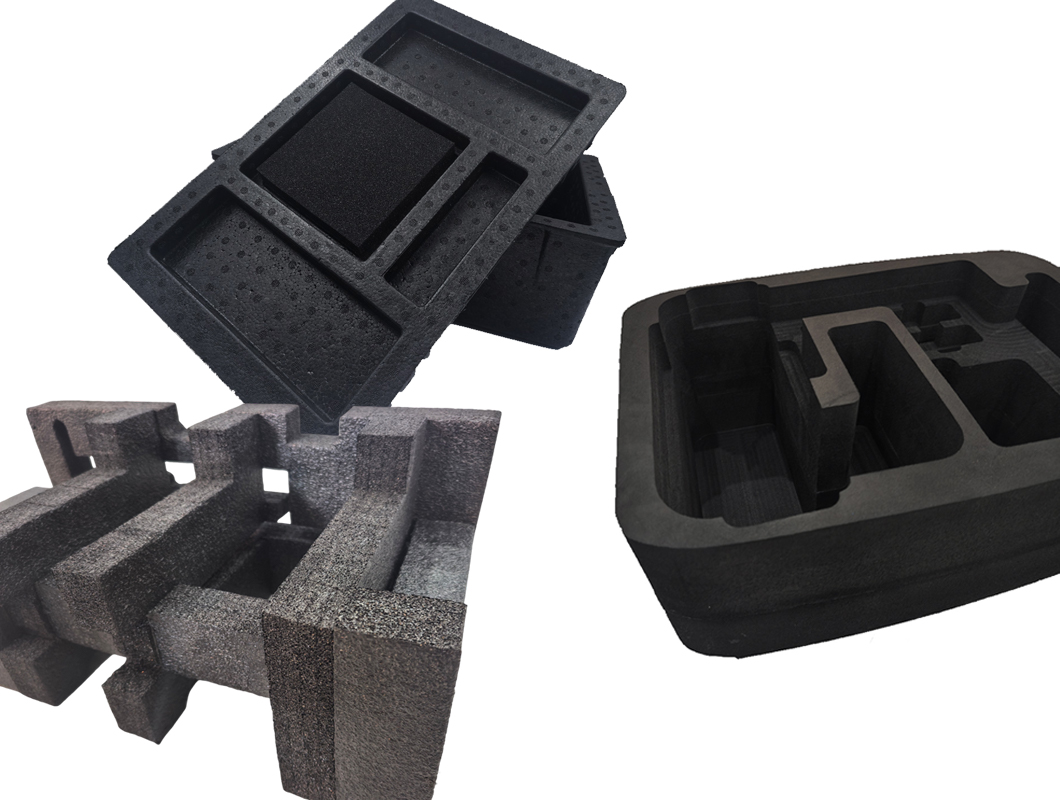
Every foam application places unique demands on material performance, often requiring a tailored balance of rigidity, flexibility, and cushioning.
These properties work against one another. Rigidity provides resistance to deformation under continuous load, maintaining structural support. Flexibility enables the foam to adapt to product shapes and evenly distribute pressure. Cushioning absorbs and dissipates energy during impacts or drops. Because each characteristic relies on different material properties, improving one typically comes at the expense of another.
Foam balance is the process of evaluating these trade-offs and engineering a system that effectively aligns all three to meet the application's requirements.
The Three Properties Are Not Interchangeable
Rigidity, flexibility, and cushioning are distinct performance variables—not simply positions along a single soft-to-firm scale. A material can be highly rigid without providing effective cushioning, and a foam that cushions well may not conform to complex shapes.
Rigidity refers to a material's resistance to deformation under sustained compressive load. It is primarily influenced by density and cell structure. Polyethylene (PE) foam, for example, is available across a broad density range, with higher densities offering increased load-bearing strength, structural integrity, and thermal stability. Its closed-cell construction also helps limit heat transfer in applications where temperature fluctuations affect performance. Cross-linked polyethylene (XLPE) enhances these properties further, maintaining tighter tolerances and resisting deformation more effectively than standard extruded PE at comparable densities.
Flexibility is the ability of a foam to compress, conform to shapes, and recover without cracking or permanent deformation. Flexible foams distribute contact forces over a larger surface area, reducing the likelihood of localized stress damage. Polyurethane foam is widely used for this purpose. As an open-cell material, it is available in a range of firmness levels and excels at distributing loads rather than concentrating them, making it ideal for applications where surface protection is critical.
Cushioning describes a foam's capacity to absorb and dissipate kinetic energy during impacts, drops, or vibration. It should not be confused with softness. A foam that is too soft may bottom out, transferring force directly to the product, while a foam that is too firm may fail to absorb enough energy. Effective cushioning depends on controlled deflection under load, which is determined through cushioning curve analysis rather than density alone.
How to Diagnose What a System Is Missing
Most packaging failures fall into three clear patterns, each pointing to a specific root cause.
If a product shifts or moves during transit, the system lacks sufficient rigidity. This is typically corrected by adding a denser structural layer—such as high-density PE, XLPE, or expanded polypropylene (EPP)—in areas that carry the greatest load.
If a product arrives with pressure marks or surface abrasion despite adequate cushioning, the issue is poor load distribution. In this case, rigid foam is concentrating force on high points rather than spreading it evenly. The solution is to introduce a conforming layer, such as polyurethane foam or low-density expanded polyethylene (EPE), at the contact interface.
If a product is held securely but still suffers impact damage, the system is missing effective cushioning. The fix is an energy-absorbing layer—EPE, EPP, or polyurethane foam—engineered to match the product's weight and drop conditions using cushioning curve data.
Diagnosing the failure pattern first leads to more accurate material selection than starting with a general foam type.
Assigning Properties to Layers
Once performance requirements are defined, each property can be matched to the material best suited to deliver it. Multi-material foam systems are commonly fabricated using processes such as heated plank lamination, followed by precision shaping through CNC routing, waterjet cutting, die cutting, or contour cutting.
For rigidity and thermal stability, high-density PE foam provides strong load-bearing support along with moisture resistance and insulation. XLPE enhances dimensional accuracy for tight-tolerance applications. Expanded polystyrene (EPS) is often used where both rigid structure and thermal insulation are required, such as in temperature-controlled shipping.
For flexibility and even load distribution, polyurethane foam is the standard choice. Its open-cell structure allows it to conform to surfaces and spread contact forces, minimizing localized pressure.
For cushioning and impact absorption, EPE offers consistent compressive strength, reliable surface protection, and an efficient strength-to-weight ratio. EPP adds the advantage of multi-impact durability, making it well-suited for reusable packaging systems.
For electrostatic discharge (ESD) protection, static-dissipative or conductive EVA, along with anti-static EVA foam, can be incorporated at the contact layer. These materials control static risk without replacing the structural and cushioning layers beneath them, allowing full system performance to be maintained.
Where Foam Balance Changes the Outcome
The three-property framework becomes critical when a single material reaches its limits and density alone cannot solve the problem.
In industrial OEM kitting, foam inserts and spacers must secure multiple components under stacking loads while preventing surface abrasion and vibration. This requires a combination of structural rigidity and effective load distribution at contact points.
For electronics and medical device packaging, multiple performance demands must be met simultaneously. Inserts need to provide reliable drop protection, control electrostatic discharge at the contact surface, and maintain dimensional stability across repeated use cycles.
Reusable dunnage systems must retain their structural integrity through continuous handling while delivering consistent cushioning performance on every trip. Material fatigue and recovery characteristics become key considerations.
In healthcare orthotics and prosthetics, products such as lumbar supports, wheelchair wedges, and custom heel lifts must maintain shape under sustained body weight, conform to patient anatomy, and relieve pressure at contact areas. These applications often require layered foam constructions, with antimicrobial properties considered alongside mechanical performance.
Marine seating and engine insulation present additional challenges. Boat seating systems combine structural foams for support with flexible foams that conform to geometry and resist moisture, mold, and chemical exposure. In engine compartments, insulation materials must reduce vibration and noise while maintaining thermal stability, often using flame-laminated polyurethane facings and foams engineered for flame resistance and heat tolerance.
For acoustic control, processes like foam convoluting create contoured, egg-crate-like profiles that increase surface area. This improves sound absorption and reduces transmission at interfaces without altering the base material density.
The Design Process
TOPSUN's engineering team offers design consultation and prototype development as part of its standard services. Each project begins with a clearly defined set of performance requirements, including load conditions, contact surfaces, impact exposure, and expected lifecycle.
With over 40 years of fabrication experience and facilities in Minnesota and Colorado, the team develops foam systems engineered to meet the specific demands of each application.
Contact TOPSUN Foam to discuss your project and determine the optimal balance of rigidity, flexibility, and cushioning tailored to your exact requirements.

 English
 العربية
 Français
 Русский
 Español
 Português
 Deutsch
 italiano
 日本語
日本語 한국어
한국어 Nederlands
 Tiếng Việt
 ไทย
ไทย Polski
 Türkçe
 ភាសាខ្មែរ
 Bahasa Melayu
 ဗမာစာ
ဗမာစာ தமிழ்
தமிழ் Filipino
 Bahasa Indonesia
 magyar
 Română
 Čeština
 қазақ
қазақ Српски
 हिन्दी
 فارسی
فارسی Kiswahili
 Norsk
Norsk Svenska
 українська
 Ελληνικά
 Suomi
Suomi עברית
עברית Latine
 Dansk
Dansk اردو
اردو বাংলা
বাংলা Afrikaans
 नेपाली
 Oʻzbekcha
 Azərbaycan dili
 Български
 guarani
 Hausa
Hausa Kurdî
Kurdî Kurdî
Kurdî Lietuvių
 Wikang Tagalog
 isiZulu


