Custom Foam Inserts vs. Off-the-Shelf Solutions: A Cost-to-Value Comparison
Foam inserts play a critical role in protecting products during shipping, handling, and storage. Insert design affects shock absorption, damage rates, freight efficiency, packing consistency, and material usage throughout distribution.
Off-the-shelf foam inserts are created for broad, general-purpose use and immediate availability. Custom foam inserts, by contrast, are engineered around a specific product and its distribution profile. Comparing these two approaches requires evaluating measurable performance outcomes—not just unit price.
How Off-the-Shelf Foam Inserts Are Used
Off-the-shelf foam inserts are manufactured in standard sizes, shapes, and densities. They accommodate a wide range of products with minimal design input and short lead times. This makes them suitable for early-stage development, limited production runs, and lower-risk applications with modest shipping exposure and lower volumes.
Because they are not tailored to a specific product, contact areas tend to be generalized. Products typically rest against flat surfaces or loosely contoured cavities, which can allow movement during transit. In simple distribution environments, this level of protection may be sufficient. However, as handling complexity and shipping distance increase, performance gaps often become more apparent.
How Custom Foam Inserts Are Engineered
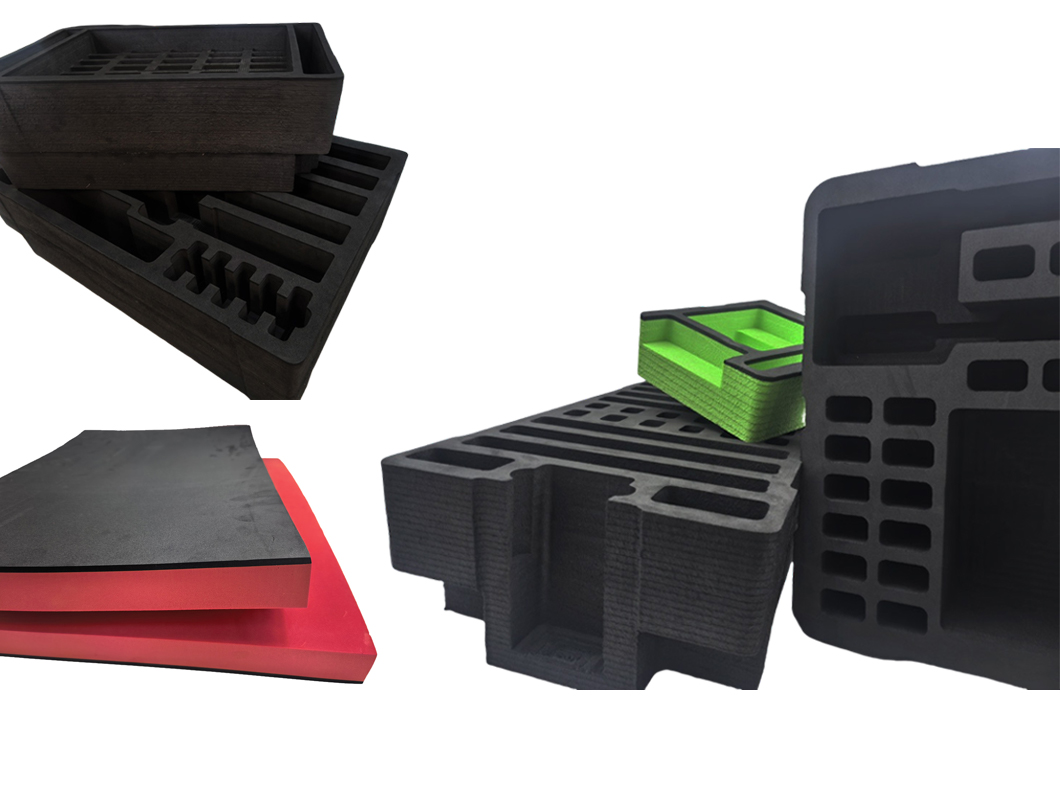
Custom foam inserts are developed around product geometry, weight, orientation, and real-world distribution conditions. Foam density, cavity design, and fabrication methods are selected to manage impact, vibration, compression, and repeated handling cycles.
At TOPSUN, insert development begins by analyzing how forces travel through a package during shipping and storage. Contact points are intentionally positioned, load paths are controlled, and internal movement is minimized through precise geometry.
Material selection is aligned with functional requirements:
●Polyethylene (PE) supports a broad range of cushioning applications and is available in multiple density options.
●Expanded Polyethylene (EPE) provides repetitive impact absorption with low weight.
●Expanded Polypropylene (EPP) delivers durability and shape retention for reusable or closed-loop systems.
●Cross-Linked Polyethylene (XLPE) offers dimensional stability for tight-tolerance inserts and case interiors.
●Polyurethane (PU) foam enables controlled cushioning response and surface protection for delicate finishes.
This engineered approach establishes predictable performance before full-scale production and supports consistency as packaging programs expand.
Fit, Contact Points, and Load Management
Insert fit directly affects how impact energy transfers to the product. Off-the-shelf inserts rely on generic cavities that may create voids and uneven load distribution. During handling, this can allow shifting, increasing exposure to shock and vibration.
Custom inserts align cavity geometry with the product’s center of gravity and structural strength. Support features are positioned where the product can safely carry load, allowing the foam to absorb energy while shielding sensitive components. This level of precision is especially valuable for electronics, assemblies with moving parts, and products sensitive to electrostatic discharge, where both material performance and geometry must work together.
Package Size and Freight Efficiency
Shipping costs are closely tied to package dimensions. Off-the-shelf inserts often require larger cartons to compensate for unused space or excess foam thickness. Increased cubic volume affects freight rates, handling efficiency, and warehouse storage.
Custom foam inserts enable packaging to be sized precisely to the product. Foam density and geometry are optimized to deliver protection with minimal material thickness. Lightweight materials such as PE and EPE support dimensional efficiency while maintaining cushioning performance. For programs with consistent shipping volume, reducing carton size can translate directly into measurable freight savings.
Material Efficiency, Yield, and Sustainability
Off-the-shelf inserts are designed for broad compatibility, which can result in excess material that does not actively contribute to product protection. Additional trimming or supplemental void fill may be required during packing, increasing labor time and material waste.
Custom foam inserts allocate material precisely where it delivers structural and cushioning performance. Wall thickness, cavity depth, and support features are engineered to meet protection requirements with minimal excess. This targeted design approach improves material yield and reduces scrap throughout production.
From a sustainability standpoint, non-crosslinked foams such as PE and EPE allow internal recycling of post-production scrap. Anti-static variations can be incorporated when product sensitivity demands it, while still maintaining durability and reuse potential. Designing inserts that prevent in-transit damage also reduces the environmental impact associated with replacement manufacturing, reshipping, and additional packaging.
Packing Consistency and Operational Throughput
Variability in packing directly affects labor efficiency and quality control. Off-the-shelf inserts may require operator adjustments or added filler to achieve acceptable protection, introducing inconsistencies across shifts and facilities.
Custom foam inserts promote repeatable packing processes. Defined cavities control product orientation and placement, enabling consistent loading. CNC-cut foam supports precise geometry and high repeatability, reducing training requirements and increasing throughput in higher-volume operations.
Durability, Reuse, and Long-Term Value
In internal distribution networks and closed-loop systems, insert durability plays a significant role in total packaging cost. Off-the-shelf foam solutions often support only a limited number of handling cycles.
Custom inserts are engineered for repeated use. EPE has a long-standing role in Class A automotive dunnage, protecting painted, chrome, glass, and powder-coated components through multiple handling cycles. EPP also performs well in reusable systems due to its resistance to permanent deformation. Extended service life distributes initial investment across more cycles, strengthening long-term value.
Evaluating Total Cost Across Distribution
Unit price represents only one element of overall packaging cost. A comprehensive evaluation considers:
●Product damage and replacement rates
●Freight costs driven by package dimensions
●Labor efficiency and packing consistency
●Material waste and scrap
●Replacement frequency in reusable systems
Custom foam inserts influence each of these variables through controlled geometry, material selection, and engineered durability. Viewing packaging as a system—rather than a single component—supports more informed decision-making for high-value or high-volume programs.
Choosing the Right Approach
Off-the-shelf inserts are well suited for short-term projects, early development stages, and lower-risk applications. Custom foam inserts are more appropriate when products are fragile, high in value, or shipped in consistent volumes.
Assessing insert performance in the context of real-world distribution conditions helps align packaging decisions with operational priorities, risk tolerance, and customer expectations.
Reassess Your Foam Insert Strategy
Packaging effectiveness depends on how material properties, geometry, and fabrication methods perform together throughout distribution. TOPSUN collaborates with engineering, operations, and procurement teams to evaluate existing packaging systems and recommend foam materials and insert designs based on shipping and handling realities.

 English
 العربية
 Français
 Русский
 Español
 Português
 Deutsch
 italiano
 日本語
日本語 한국어
한국어 Nederlands
 Tiếng Việt
 ไทย
ไทย Polski
 Türkçe
 ភាសាខ្មែរ
 Bahasa Melayu
 ဗမာစာ
ဗမာစာ தமிழ்
தமிழ் Filipino
 Bahasa Indonesia
 magyar
 Română
 Čeština
 қазақ
қазақ Српски
 हिन्दी
 فارسی
فارسی Kiswahili
 Norsk
Norsk Svenska
 українська
 Ελληνικά
 Suomi
Suomi עברית
עברית Latine
 Dansk
Dansk اردو
اردو বাংলা
বাংলা Afrikaans
 नेपाली
 Oʻzbekcha
 Azərbaycan dili
 Български
 guarani
 Hausa
Hausa Kurdî
Kurdî Kurdî
Kurdî Lietuvių
 Wikang Tagalog
 isiZulu


