EPP Insulated Cooler Boxes from 6.5L to 108L
Topsun supplies reusable EPP insulated cooler boxes in capacities from 6.5L to 108L for cold chain logistics, food delivery, pharmaceutical transport, biological samples, catering distribution and reusable transport packaging.
Made from Expanded Polypropylene foam, EPP boxes combine thermal insulation, impact absorption, low weight, moisture resistance and durability. The product range includes compact portable boxes, medium-size delivery containers and large-volume cold chain transport boxes with different dimensions, densities and handle configurations.
Buyers can select from existing box sizes or request custom capacity, outer dimensions, inner dimensions, density, color, logo, lid structure, handles, inserts, dividers and other molded features according to the payload and logistics process.
EPP Insulated Cooler Box Range
| Item | Product Information |
| Product | EPP Insulated Cooler Boxes |
| Material | Expanded Polypropylene Foam / EPP |
| Available Capacity | 6.5L to 108L in the Current Product Range |
| Listed Standard Densities | 26, 35, 45 and 60 kg/m³ Depending on Model |
| Custom Density Range | 20–190 kg/m³ According to Project Requirements |
| Handle Options | Standard Box, No Handle or Handle-Rope Designs Depending on Model |
| Customization | Capacity, Size, Density, Color, Logo, Lid, Handles, Inserts, Dividers and Molded Structure |
| Main Applications | Cold Chain, Food Delivery, Pharmaceutical Transport, Biological Samples and Reusable Logistics |
EPP Insulated Cooler Box Product Image
Why Choose EPP for Reusable Insulated Boxes?
Thermal insulation: the EPP cellular structure helps slow heat transfer between the payload and surrounding environment.
Impact absorption: molded EPP helps protect products against shocks during loading, unloading, stacking and transportation.
Lightweight: low container weight helps reduce manual handling effort and transport weight.
Reusable construction: EPP has good deformation recovery and is suitable for repeated distribution cycles under appropriate handling conditions.
Low water absorption: suitable for applications involving condensation, cold packs and humid transport environments.
Wide size selection: the current range covers compact 6.5L containers through large 108L transport boxes.
Multiple density options: buyers can select different densities according to weight, impact and structural requirements.
Custom molded construction: EPP can be molded into lids, handles, dividers, inserts and application-specific box structures.
Recyclable polypropylene material: EPP can enter suitable polypropylene recycling streams where collection and processing facilities are available.
EPP Insulated Box Size and Capacity Selection
The current Topsun EPP box range provides different capacities, external dimensions, internal dimensions, densities and weights. This allows distributors, cold-chain operators, food-service companies and packaging engineers to select a box according to the actual payload rather than using one container size for every application.
| EPP Foam Box Selection List |
| Type | Capacity | Outer Dimensions | Inner Dimensions | Density | Weight | Typical Use |
| Standard, No Handle | 108L | 665×520×500 mm | 605×460×420 mm | 60 kg/m³ | 2800 g | Large cold chain transport |
| 81L | 660×510×385 mm | 600×450×300 mm | 60 kg/m³ | 2400 g | Food and pharmaceutical logistics |
| 68L | 660×480×395 mm | 510×410×315 mm | 60 kg/m³ | 2300 g | Reusable delivery container |
| 67L | 635×470×405 mm | 555×410×315 mm | 60 kg/m³ | 2250 g | Temperature-sensitive cargo |
| 62L | 560×440×360 mm | 500×380×300 mm | 60 kg/m³ | 2000 g | Cold storage turnover box |
| 56L | 500×440×400 mm | 440×380×340 mm | 45 kg/m³ | 1200 g | Lightweight insulated packaging |
| 43L | 490×380×400 mm | 430×320×340 mm | 45 kg/m³ | 1000 g | Food delivery and storage |
| 34L | 600×400×260 mm | 540×340×200 mm | 60 kg/m³ | 1350 g | Stackable cold chain box |
| 34L | 600×400×260 mm | 540×340×200 mm | 45 kg/m³ | 1100 g | Lightweight turnover box |
| 32L | 595×375×280 mm | 515×295×200 mm | 26 kg/m³ | 800 g | Short-distance delivery |
| 32L | 595×375×280 mm | 515×295×200 mm | 45 kg/m³ | 1100 g | Medium-duty insulated box |
| 18L | 395×275×305 mm | 345×225×255 mm | 35 kg/m³ | 640 g | Sample transport |
| 18L | 395×275×305 mm | 345×225×255 mm | 26 kg/m³ | 360 g | Small lightweight cooler box |
| With Handle Ropes | 23L | 560×240×310 mm | 510×175×260 mm | 26 kg/m³ | 480 g | Portable food delivery |
| 22L | 420×330×265 mm | 370×280×210 mm | 26 kg/m³ | 440 g | Takeaway insulated box |
| 17L | 400×290×255 mm | 350×240×210 mm | 26 kg/m³ | 400 g | Small cold chain box |
| 14.5L | 516×186×250 mm | 480×150×200 mm | 26 kg/m³ | 370 g | Long narrow insulated box |
| 14L | 400×290×210 mm | 350×240×170 mm | 26 kg/m³ | 330 g | Personal cooler box |
| 12L | 410×244×204 mm | 365×200×165 mm | 26 kg/m³ | 260 g | Small delivery box |
| 8.5L | 310×180×255 mm | 270×140×205 mm | 26 kg/m³ | 170 g | Compact cold storage box |
| 6.5L | 310×180×255 mm | 270×140×175 mm | 26 kg/m³ | 150 g | Mini insulated box |
Dimensions, density, weight and application descriptions above refer to the current listed models. Confirm final specifications before ordering.
EPP Foam Box Specification Image
EPP Insulated Cooler Box Video
How to Choose the Right EPP Cooler Box Capacity
Box capacity should be selected according to the actual payload rather than simply choosing the largest available container. Excessive empty space can make payload positioning and temperature management more difficult.
| Capacity Group | Typical Models | Suitable Project Type |
| Compact | 6.5L, 8.5L, 12L, 14L, 14.5L | Small deliveries, samples, individual packs and compact cold-chain routes. |
| Small / Portable | 17L, 18L, 22L, 23L | Takeaway, laboratory samples, food delivery and portable distribution. |
| Medium | 32L, 34L, 43L, 56L | Food-service routes, chilled products, pharmacy distribution and reusable logistics. |
| Large | 62L, 67L, 68L, 81L, 108L | High-volume cold chain, warehouse distribution and larger temperature-sensitive loads. |
How Density Affects EPP Box Selection
EPP density influences box weight, firmness, structural support and impact behavior. Density should therefore be selected together with the container dimensions, wall structure, payload and expected handling conditions.
| Listed Density | Typical Selection Consideration |
| 26 kg/m³ | Lightweight compact and portable box configurations. |
| 35 kg/m³ | Intermediate construction for selected small transport boxes. |
| 45 kg/m³ | Medium-duty reusable insulated box configurations. |
| 60 kg/m³ | Large or higher-duty transport box configurations in the current product range. |
Custom EPP densities can also be evaluated where a standard model does not meet the required balance of weight, impact resistance and structural performance.
EPP Boxes for Cold Chain Logistics
EPP insulated boxes can form the reusable outer container in passive cold-chain packaging systems for chilled food, beverages, fresh products, pharmaceutical goods and other temperature-sensitive payloads.
The container can be combined with ice packs, gel packs, PCM packs or other suitable cooling media according to the required transport conditions.
Temperature retention depends on the complete system, including box size, wall construction, payload quantity, starting product temperature, coolant type and quantity, ambient temperature and route duration.
EPP Boxes for Food Delivery and Catering
EPP transport boxes are suitable for professional food-service operations including central kitchens, catering distribution, takeaway delivery, bakery transport, meal distribution and branch replenishment.
Smaller models with handle ropes provide portable options for delivery routes, while larger models are suitable for bulk movement of trays, packages and multiple food containers.
The internal dimensions should be matched closely to the food package or tray dimensions while allowing the required space for coolant or other temperature-control components.
EPP Boxes for Pharmaceutical and Biological Sample Transport
EPP containers can be evaluated as part of passive temperature-controlled packaging systems for pharmaceuticals, diagnostic materials, biological samples and laboratory shipments.
For temperature-critical or regulated shipments, the complete packaging configuration should be validated using the intended EPP box, payload, coolant arrangement, temperature monitor, ambient profile and route duration.
Buyers should provide the required temperature range, hold time, payload dimensions and applicable packaging qualification requirements when selecting a box for pharmaceutical or laboratory use.
Reusable EPP Transport Boxes for Closed-Loop Logistics
EPP boxes are particularly suitable for closed-loop logistics where containers move repeatedly between factories, warehouses, distribution centers, stores, kitchens, laboratories or other fixed locations.
Reusable systems can reduce dependence on single-use packaging while providing consistent container geometry for stacking, loading and delivery operations.
Containers should be inspected between cycles for cracks, damaged corners, deformation and lid-fit changes that could affect protection or thermal performance.
Temperature Retention and Coolant Planning
Selected EPP box configurations can support approximately 24 hours of insulation under suitable usage conditions, but this should not be treated as a universal holding time for every model or shipment.
Actual temperature performance depends on the complete packout and transport profile.
| Factor | Effect on Transport Performance |
| Box Capacity | Changes payload volume, surface area and available coolant space. |
| Wall Thickness | Influences heat transfer through the container structure. |
| Payload Temperature | Starting product temperature contributes to the total thermal load. |
| Coolant Type | Ice packs, gel packs or PCM systems provide different thermal behavior. |
| Coolant Quantity | More or less coolant changes the thermal capacity of the packout. |
| Ambient Temperature | External conditions determine the thermal load placed on the box. |
| Transport Duration | Longer routes require temperature control for a longer period. |
| Lid Opening | Repeated opening introduces external air and can increase temperature fluctuation. |
Why EPP Foam Is Suitable for Insulated Transport Boxes
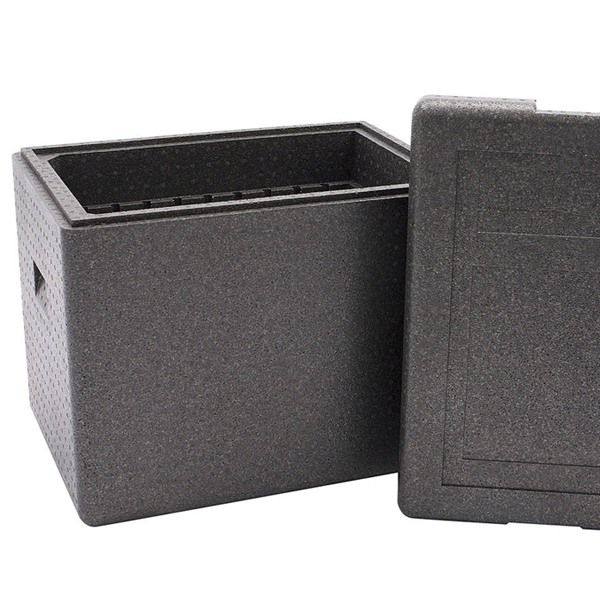
EPP combines lightweight construction with energy absorption and deformation recovery, making it suitable for reusable transport applications where boxes experience repeated loading, unloading and handling.
Its closed-cell foam structure provides thermal insulation and low water absorption, which are useful for chilled goods and applications involving cold packs or condensation.
Molded EPP also allows the container geometry to be designed around the logistics process, including lids, handles, inserts, dividers, stacking features and identification areas.
Custom EPP Insulated Box Options
Existing box sizes are suitable for many standard applications, while OEM projects can be developed when the payload, vehicle, pallet or distribution workflow requires a different container structure.
| Customization Item | Available Options |
| Size and Capacity | Custom outer dimensions, inner dimensions, wall thickness and usable capacity. |
| Density | Different EPP densities according to weight, impact and structural requirements. |
| Color | Grey, black, white, pink and other colors depending on project and quantity. |
| Branding | Customer logo, molded marks and brand identification. |
| Handle Design | Without handle, handle-rope construction or project-specific carrying structure. |
| Lid Structure | Custom molded lid according to opening, handling and packing requirements. |
| Internal Inserts | Payload positioning, protection and coolant separation. |
| Dividers | Separation of products, temperature zones or coolant positions where suitable. |
| Stacking Features | Container geometry for warehouse, vehicle and return-logistics handling. |
Information to Provide for EPP Cooler Box Selection
Payload type: food, beverages, pharmaceuticals, laboratory samples or industrial products.
Product dimensions: length, width and height of individual packs or containers.
Quantity per box: number of products loaded in each transport container.
Required capacity: indicate the target volume if already known.
Payload weight: provide total loaded weight.
Temperature requirement: specify the target transport range for temperature-sensitive applications.
Transport duration: provide the expected route or holding time.
Ambient conditions: provide expected external temperature where known.
Coolant arrangement: identify ice packs, gel packs, PCM or other cooling components.
Handling requirement: indicate whether handles, handle ropes or stacking features are needed.
Branding: provide color and logo requirements.
Estimated quantity: provide sample, trial and production requirements.
Topsun EPP Box and Foam Processing Capabilities
Topsun supports molded EPP box development together with foam converting for packaging and industrial applications.
1. Custom Molded Parts: EPP boxes, lids and other three-dimensional molded components can be evaluated according to drawings and application requirements.
2. Cutting: foam materials can be cut according to customer dimensions.
3. Slicing: foam materials can be sliced according to required thickness.
4. Lamination: hot-melt film, flame and pressure-sensitive adhesive lamination can be evaluated for suitable foam products.
5. Laser Cutting: suitable foam parts can be processed according to digital drawings.
6. Die Cutting: repeatable custom foam parts can be manufactured according to customer designs.
7. Compression Molding: three-dimensional molded foam and foam composite components can be manufactured for suitable projects.
8. Engraving: suitable for packaging inserts, tool inserts and shaped foam cavities.
9. Silk-Screen Printing: logos and patterns can be printed on suitable foam surfaces.
10. Adhesive Backing: adhesive and release liners can be applied to suitable foam products.
Other Foam Materials Available from Topsun
Topsun supplies EPP molded products together with EVA foam, PE foam, XPE foam, IXPE foam, CR foam, EPDM foam, neoprene foam, SBR foam, NBR foam, NBR/PVC foam and micro-cell soft PVC foam in sheet, roll, block and custom converted forms.
About Topsun Foam
Topsun supplies EPP insulated boxes, molded EPP components and foam materials for cold chain, food delivery, packaging, automotive and industrial applications. Buyers can provide existing box requirements, drawings, samples or complete payload and logistics information for product evaluation.
Our facility is located in Changzhou City, Jiangsu Province, China, with convenient access to Shanghai Port for international shipments.
EPP Insulated Cooler Box FAQ
What is an EPP insulated cooler box?
An EPP insulated cooler box is a reusable container manufactured from Expanded Polypropylene foam. It combines thermal insulation, lightweight construction and impact protection for suitable transport and distribution applications.
What capacities of EPP insulated boxes does Topsun offer?
The current listed range covers capacities from 6.5L to 108L, including compact portable boxes, medium-size delivery containers and large cold-chain transport boxes.
What densities are available for the current EPP box models?
Current standard models in the selection table use 26, 35, 45 and 60 kg/m³ EPP. Custom density requirements can also be evaluated according to the project.
What are EPP insulated boxes used for?
Typical applications include cold-chain logistics, food delivery, catering distribution, fresh-food transport, pharmaceutical shipments, biological samples, reusable transport packaging and protective logistics.
How do I choose the right EPP cooler box size?
Start with the payload dimensions, number of items per box and required coolant space. Then compare the internal dimensions and capacity of the available models. External dimensions should also be checked against vehicles, shelves, pallets and other logistics equipment.
Should I choose the largest available cooler box?
Not necessarily. A box should match the payload and required coolant layout as closely as practical. Excessive unused internal space can make product positioning and temperature management less efficient.
How long can an EPP cooler box keep products cold?
Selected configurations can support approximately 24 hours of insulation under suitable conditions, but there is no universal holding time. Actual performance depends on box size, wall construction, payload, coolant arrangement, ambient temperature and transport duration.
Does an EPP insulated box require ice packs?
Many chilled transport applications use ice packs, gel packs, PCM packs or other cooling media. The type and quantity should be selected according to the required temperature range and route conditions.
Can EPP boxes be used for pharmaceutical transport?
EPP boxes can be evaluated as part of temperature-controlled pharmaceutical packaging systems. Temperature-critical shipments should use a validated packout based on the required temperature range, coolant arrangement, payload and transport profile.
Can EPP boxes be used for biological samples?
Yes, suitable EPP boxes can be evaluated for biological and laboratory sample transport when used as part of a packaging system designed for the required temperature and handling conditions.
Are EPP insulated boxes reusable?
EPP has good impact resilience and deformation recovery, making it suitable for repeated-use logistics. Containers should be inspected between cycles for damage that could affect structural or thermal performance.
Can EPP boxes be cleaned and reused?
EPP has low water absorption and is suitable for reusable transport applications. The cleaning process should be selected according to the contamination, box design and hygiene requirements of the application.
Are EPP insulated boxes recyclable?
EPP is a polypropylene-based foam and can be recycled where appropriate collection and polypropylene recycling facilities are available.
Can Topsun customize the box capacity and dimensions?
Yes. Custom outer dimensions, inner dimensions, capacity, wall structure and molded geometry can be evaluated according to payload and logistics requirements.
Can EPP boxes be made with handles?
Yes. The current range includes standard boxes and models with handle ropes. Custom handle structures can also be evaluated for new molded projects.
Can Topsun add a custom logo to EPP boxes?
Customer logos, molded marks and other brand identification can be evaluated according to the box design and order requirements.
Can dividers or inserts be added inside an EPP box?
Yes. Internal dividers and inserts can be developed for product positioning, impact protection, coolant separation or other packaging requirements.
What information should I provide for an EPP box quotation?
Please provide the payload type, product dimensions, quantity per box, required capacity, payload weight, target temperature, transport duration, ambient conditions, coolant arrangement, handle requirement, logo or color requirement and estimated quantity.
How can I request an EPP insulated box sample?
Send your requirements to july@topsunfoam.com, including capacity, dimensions, density, application, customization requirements and estimated quantity for evaluation.

 English
 العربية
 Français
 Русский
 Español
 Português
 Deutsch
 italiano
 日本語
 한국어
 Nederlands
 Tiếng Việt
 ไทย
 Polski
 Türkçe
 ភាសាខ្មែរ
 Bahasa Melayu
 ဗမာစာ
 தமிழ்
 Filipino
 Bahasa Indonesia
 magyar
 Română
 Čeština
 қазақ
 Српски
 हिन्दी
 فارسی
 Kiswahili
 Norsk
 Svenska
 українська
 Ελληνικά
 Suomi
 עברית
 Latine
 Dansk
 اردو
 বাংলা
 Afrikaans
 नेपाली
 Oʻzbekcha
 Azərbaycan dili
 Български
 guarani
 Hausa
 Kurdî
 Kurdî
 Lietuvių
 Wikang Tagalog
 isiZulu


