EPP Bumper Energy Absorber and Bumper Core
Topsun custom molded EPP bumper energy absorber is a lightweight automotive component designed for impact energy management inside front or rear bumper systems. It can also be referred to as an EPP bumper core, bumper absorber or face bar absorber depending on the vehicle and component terminology.
Expanded Polypropylene foam combines low weight, impact energy absorption, deformation recovery and complex molding capability. These properties allow the absorber geometry to be developed around the bumper cover, reinforcement structure, available installation space and required vehicle assembly.
Topsun supplies molded EPP automotive parts in a density range of 30–110 g/L. Bumper absorbers can be customized according to 2D drawings, 3D CAD models, original samples, required density, component geometry, installation position and project-specific validation requirements.
EPP Bumper Absorber Product Information
| Item | Product Information |
| Product | EPP Bumper Energy Absorber / Bumper Core |
| Material | Expanded Polypropylene Foam / EPP |
| Application | Automotive Front and Rear Bumper Systems |
| Density Range | 30–110 g/L |
| Standard Color | Black |
| Size | Customized According to Vehicle and Component Design |
| Geometry | Custom Molded According to Drawing, 3D Model or Sample |
| Production Method | Custom Tooling and EPP Particle Foam Molding |
| Main Function | Impact Energy Management, Lightweight Protection and Structural Integration |
Why EPP Is Used for Automotive Bumper Absorbers
A bumper energy absorber is installed as part of the complete bumper assembly and is designed to deform under impact so that part of the impact energy can be managed within the bumper system.
EPP is well suited to this application because it provides energy absorption at relatively low material weight. Its resilient cellular structure also provides deformation recovery under suitable loading conditions.
Because EPP is molded directly into three-dimensional components, the bumper absorber can follow complex vehicle geometry and incorporate local ribs, recesses, channels, curved sections and positioning features.
Final impact performance depends on the complete bumper assembly, including absorber density, component geometry, thickness, reinforcement structure, bumper cover, available deformation space and vehicle-specific validation requirements.
Benefits of EPP Bumper Energy Absorbers
Impact energy absorption: cellular EPP can deform under impact and contribute to energy management within the bumper assembly.
Low component weight: EPP adds relatively little mass compared with many solid structural materials.
Deformation recovery: the material can recover after suitable compression and impact within its design limits.
Complex molded geometry: curved profiles, ribs, cavities, recesses and positioning features can be incorporated into the component.
Density selection: 30–110 g/L allows the material to be evaluated for different impact, support and weight requirements.
Low water absorption: EPP is suitable for vehicle areas where moisture exposure must be considered.
Dimensional integration: molded components can be developed around the bumper cover, reinforcement and adjacent vehicle components.
Production repeatability: dedicated molds support repeated manufacturing of approved component geometry.
Recyclable polypropylene: EPP is polypropylene-based and can enter suitable recycling streams where collection and processing are available.
EPP Bumper Absorber Specification
| Specification Item | Available Specification |
| Application | Automotive Bumper Parts |
| Density | 30–110 g/L |
| Material | Expanded Polypropylene Foam / EPP |
| Color | Black |
| Part Size | Customized |
| Mold | Custom Tooling According to Component Geometry |
EPP Automotive Bumper Parts Video
What Is an EPP Automotive Bumper Energy Absorber?
An EPP bumper absorber is a molded expanded polypropylene component incorporated into the vehicle bumper assembly. Depending on the bumper architecture, it may be positioned between the bumper cover and structural reinforcement or within another designated energy-management area.
During an impact, the cellular structure can deform and absorb part of the mechanical energy. The geometry of the component can be tuned through density, local section thickness, ribs and available compression distance.
The component should therefore be engineered as part of the complete bumper system rather than treated as an independent universal safety device.
Front and Rear EPP Bumper Cores
Custom EPP bumper cores can be developed for both front and rear bumper assemblies according to vehicle-specific geometry.
Front and rear systems can have different installation space, curvature, reinforcement geometry, impact targets and assembly interfaces, so each component should be designed according to its actual vehicle position.
Topsun can evaluate parts from OEM drawings, Tier supplier drawings, 3D models, existing samples or complete dimensional requirements.
Bumper Core Geometry and Energy Management
Bumper absorber performance is determined by more than material density. Component geometry is equally important because it controls how and where the foam deforms under load.
| Design Factor | Why It Matters |
| EPP Density | Influences compression behavior, support and impact response. |
| Part Thickness | Defines available deformation distance in different regions of the absorber. |
| Rib Geometry | Can provide local support and controlled deformation according to the design. |
| Curvature | Allows the component to follow bumper cover and reinforcement geometry. |
| Compression Space | Determines how much deformation is physically available during impact. |
| Mating Surfaces | Control fit with surrounding vehicle components. |
| Locating Features | Help position the absorber during vehicle assembly. |
Selecting EPP Density for a Bumper Absorber
Topsun's current automotive EPP range covers densities from 30 to 110 g/L. The appropriate density cannot be selected from vehicle size alone.
Density should be evaluated together with absorber thickness, compression distance, component geometry, target weight, bumper architecture and required impact performance.
For impact-related automotive components, the final density and geometry should be confirmed through the customer's required component or complete bumper-system testing.
Custom Molded Bumper Absorber Geometry
Particle foam molding allows EPP bumper absorbers to be manufactured as complex three-dimensional parts rather than simple cut foam blocks.
Depending on project feasibility, molded geometry can include curved surfaces, ribs, local thickness changes, recesses, channels, positioning areas and other features required to fit the surrounding bumper assembly.
Critical dimensions, mating areas and impact-related sections should be clearly identified in the engineering data before tooling development.
Automotive EPP Application Reference
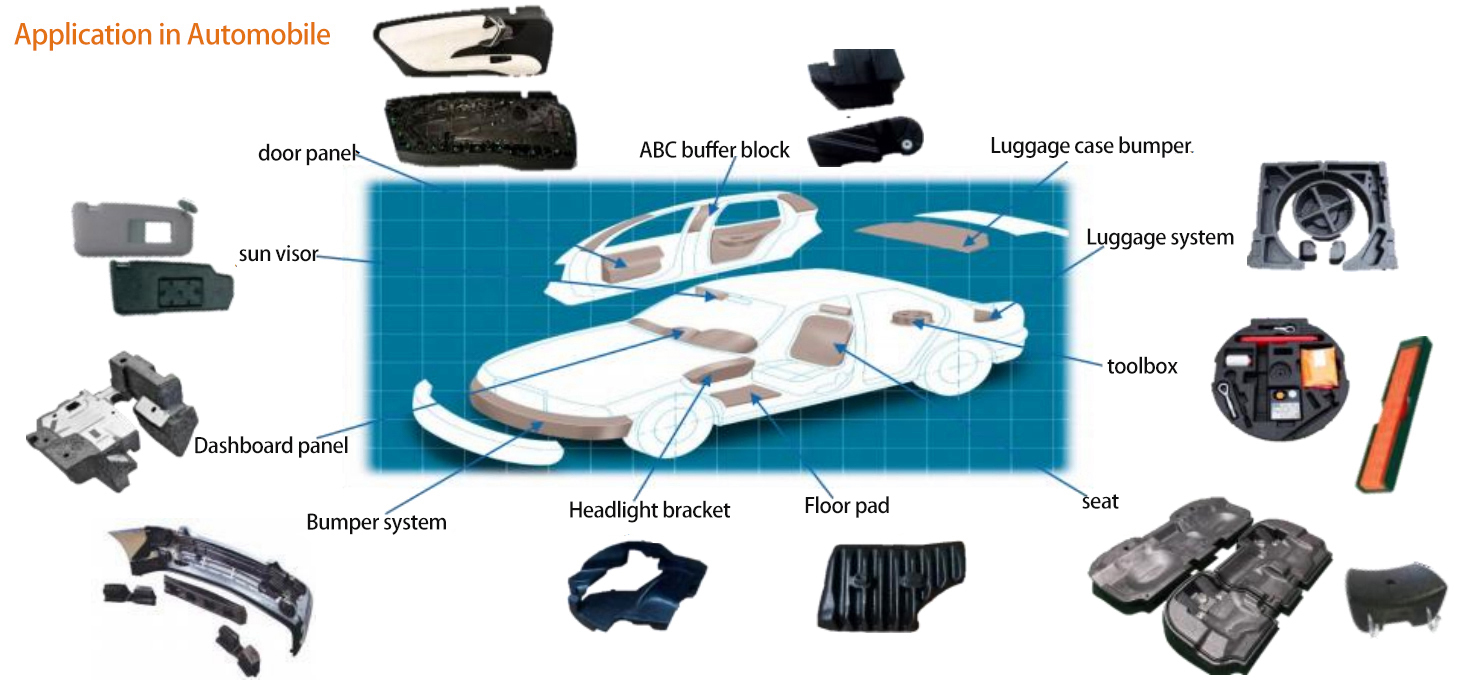
EPP is also used in other automotive components including floor pads, door and dashboard inserts, seating-related parts, luggage systems, storage components and protective structures. For this product page, the primary application is the molded bumper energy absorber and bumper core.
Custom EPP Bumper Absorber Development
Topsun supports custom bumper absorber projects from drawing review through mold development, sample production and batch manufacturing.
| Development Step | Information Required |
| Vehicle Application | Front or rear bumper position, component function and surrounding assembly information. |
| 3D CAD Model | 3D geometry showing component shape, ribs, curves, cavities and mating surfaces. |
| 2D Drawing | Critical dimensions, tolerances and inspection requirements. |
| Existing Sample | Original absorber or reference part where drawing information is incomplete. |
| Density Requirement | Specified density or required performance data for material selection. |
| Impact Requirement | Customer-defined energy-management or impact-validation criteria. |
| Assembly Method | Positioning, mating surfaces and interaction with surrounding bumper components. |
| Mold Development | Confirmed geometry, density range and sample approval requirements. |
| Sample Validation | Dimensional inspection, assembly fit and customer-defined functional testing. |
| Production Planning | Annual demand, packaging method and batch delivery requirements. |
Information to Provide for an EPP Bumper Absorber Quote
Front or rear bumper application
3D CAD model if available
2D engineering drawing
Physical sample or sample photos where applicable
Required component dimensions
EPP density if already specified
Target part weight
Available compression or deformation space
Impact or energy-management requirement
Critical dimensions and tolerances
Assembly and locating requirements
Applicable automotive test requirements
Prototype quantity
Expected annual volume
Topsun Foam Processing Capabilities
In addition to molded EPP automotive parts, Topsun provides foam converting capabilities for industrial foam materials, packaging inserts and custom foam components.
1. Cutting: foam sheets, blocks and suitable parts can be cut according to customer dimensions.
2. Slicing: foam materials can be sliced to the required thickness.
3. Lamination: hot-melt film, flame and pressure-sensitive adhesive lamination are available for suitable materials.
4. Laser Cutting: suitable foam shapes can be cut according to digital drawings without three-dimensional EPP molding tooling.
5. Die Cutting: repeatable foam pads, seals and inserts can be manufactured according to customer designs.
6. Compression Molding: three-dimensional molded foam and foam composite components can be manufactured for suitable applications.
7. Engraving: suitable for tool box inserts, packaging inserts and custom cavities.
8. Silk-Screen Printing: logos and patterns can be printed on suitable foam surfaces.
9. Adhesive Backing: pressure-sensitive adhesive and release liner can be applied to suitable foam products.
Other Foam Materials Available from Topsun
Topsun supplies molded EPP components together with EVA foam, PE foam, XPE foam, IXPE foam, CR foam, EPDM foam, neoprene foam, SBR foam, NBR foam and micro-cell soft PVC foam in sheet, roll, block and custom converted forms.
About Topsun Foam
Topsun supplies custom molded EPP automotive components and foam materials for automotive manufacturers, component suppliers, aftermarket projects and industrial customers. Bumper absorber projects can be evaluated from drawings, 3D models, physical samples or detailed vehicle-component requirements.
Our facility is located in Changzhou City, Jiangsu Province, China, with convenient access to Shanghai Port for international shipments.
EPP Bumper Energy Absorber FAQ
What is an EPP bumper energy absorber?
An EPP bumper energy absorber is a molded expanded polypropylene component used within an automotive bumper assembly to help manage impact energy while keeping component weight relatively low.
Is an EPP bumper absorber the same as a bumper core?
The terms bumper absorber, bumper energy absorber and bumper core are often used for molded energy-absorbing foam components within bumper assemblies. Exact terminology can vary by vehicle manufacturer and bumper design.
Why is EPP used for bumper cores?
EPP combines low weight, impact energy absorption, deformation recovery and complex three-dimensional molding capability, making it suitable for automotive energy-management components.
What EPP density can Topsun supply for bumper absorbers?
Topsun's current automotive EPP range covers 30–110 g/L. The appropriate density depends on geometry, component thickness, available deformation space, target weight and required impact behavior.
Is higher-density EPP always better for a bumper absorber?
No. Density must be matched to geometry and the required deformation behavior. A higher density is not automatically better because bumper performance depends on the complete component and bumper-system design.
Can Topsun make front and rear bumper absorbers?
Custom molded EPP components can be evaluated for front or rear bumper systems according to the supplied vehicle geometry, drawings and functional requirements.
Can the bumper absorber be customized from a 3D CAD file?
Yes. A 3D CAD model is preferred for complex custom bumper absorber geometry. A 2D drawing, original sample or detailed component requirements can also be reviewed.
Can Topsun copy an existing bumper absorber sample?
An existing component can be provided as a dimensional and structural reference. Additional application, material, tolerance and functional requirements may still be needed before tooling development.
Does a custom EPP bumper core require tooling?
A custom three-dimensional molded EPP bumper core normally requires dedicated tooling corresponding to the approved component geometry.
Can ribs and curved surfaces be molded into EPP bumper absorbers?
Yes. Depending on manufacturing feasibility, EPP components can incorporate curved surfaces, ribs, recesses, cavities, channels and other three-dimensional features.
Does EPP recover after impact?
EPP has resilient deformation characteristics and can recover after suitable compression or impact. Recovery depends on density, geometry, impact severity and the limits of the finished design.
Is EPP suitable for safety-related automotive parts?
EPP is widely used in automotive energy-management applications. Safety-related components should be engineered and validated according to the complete vehicle or bumper system and the customer's applicable testing requirements.
Is EPP water resistant?
EPP has low water absorption, making it suitable for many automotive applications where exposure to moisture needs to be considered.
Is EPP recyclable?
EPP is polypropylene-based and can be recycled where suitable collection and polypropylene recycling systems are available.
What information should I provide for an EPP bumper absorber quote?
Please provide the front or rear application, 3D CAD model or 2D drawing, dimensions, EPP density if specified, target weight, available compression space, impact requirement, tolerances, assembly details, validation requirements and estimated annual volume.
How can I request an EPP bumper absorber sample?
Send your project information to july@topsunfoam.com, including the drawing or sample, component dimensions, density if known, vehicle application and estimated quantity for evaluation.

 English
 العربية
 Français
 Русский
 Español
 Português
 Deutsch
 italiano
 日本語
 한국어
 Nederlands
 Tiếng Việt
 ไทย
 Polski
 Türkçe
 ភាសាខ្មែរ
 Bahasa Melayu
 ဗမာစာ
 தமிழ்
 Filipino
 Bahasa Indonesia
 magyar
 Română
 Čeština
 қазақ
 Српски
 हिन्दी
 فارسی
 Kiswahili
 Norsk
 Svenska
 українська
 Ελληνικά
 Suomi
 עברית
 Latine
 Dansk
 اردو
 বাংলা
 Afrikaans
 नेपाली
 Oʻzbekcha
 Azərbaycan dili
 Български
 guarani
 Hausa
 Kurdî
 Kurdî
 Lietuvių
 Wikang Tagalog
 isiZulu