English


pu foam
Topsun
22, 25, 28, 30kgs/M3
30*30mm


Product Description
Topsun sound absorption polyurethane foam sheet is a flexible open-cell PU foam material designed for machinery enclosures, equipment housings, automotive NVH components, acoustic liners and other industrial applications where reflected sound and reverberation need to be reduced.
The interconnected pore structure allows airborne sound to enter the foam, where part of the acoustic energy can be dissipated inside the cellular network. Open-cell PU foam is therefore commonly used as an internal acoustic lining rather than as a heavy sound-blocking barrier.
Topsun's current product range includes densities of 22, 25, 28 and 30 kg/m³. The referenced technical grade has a density specification of 23±2 kg/m³ with a recorded result of 22.42 kg/m³. Sheets can also be cut, laminated, die-cut and supplied with adhesive backing for suitable installations.
Open-cell structure: interconnected pores allow sound and air to enter the foam structure.
Sound absorption: helps reduce reflected airborne sound and reverberation inside suitable enclosures and assemblies.
Lightweight: low-density PU foam can be incorporated into equipment and vehicle components without adding substantial mass.
Flexible cushioning: compressible foam can also provide cushioning between components.
Vibration damping: suitable for selected acoustic and NVH assemblies where both airborne sound and mechanical contact need to be considered.
Multiple density options: current product information includes 22, 25, 28 and 30 kg/m³.
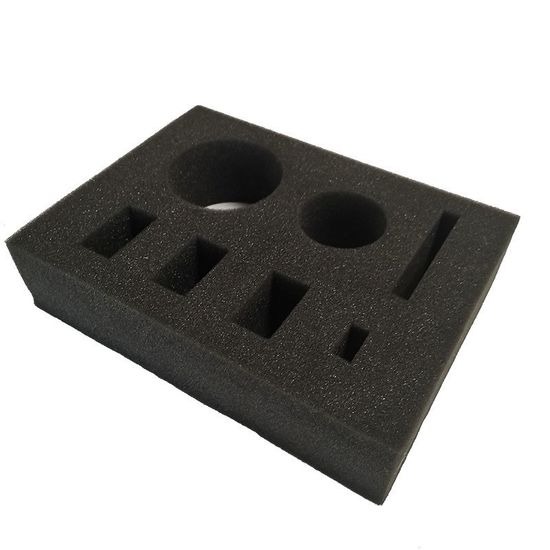
Custom cutting: foam can be fabricated into sheets, pads, strips and shaped acoustic components.
Adhesive backing: suitable PU foam can be laminated with pressure-sensitive adhesive for installation on panels and equipment surfaces.
Custom lamination: suitable facing materials or composite constructions can be evaluated according to the finished application.
| Item | Product Information |
| Material | Polyurethane Foam / PU Foam |
| Cell Structure | Open Cell |
| Current Density Options | 22, 25, 28 and 30 kg/m³ |
| Referenced Technical Grade | 23±2 kg/m³ |
| Referenced Tensile Strength | ≥90 kPa |
| Referenced Elongation at Break | ≥100% |
| Available Forms | Sheet, Pad, Strip and Custom Cut Parts |
| Adhesive Option | Available for Suitable Applications |
| Typical Applications | Machinery Enclosures, Equipment Housings, Automotive NVH, Acoustic Liners and Industrial Noise-Control Components |
The following technical data applies to the referenced polyurethane foam grade currently provided with this product. Final physical properties should be confirmed according to the selected density, thickness, formulation and finished application.
| Testing Item | Unit / Condition | Test Method / Reference | Specification | Test Result |
| Density | kg/m³ | GB/T 6343-2009 | 23±2 | 22.42 |
| Resilience / Ball Rebound | % | GB/T 6670-2008 | ≥30 | 33.95 |
| Hardness | Shore C | LX-F | ≥70 | 82 |
| Elongation at Break | % | GB/T 6344-2008 | ≥100 | 122.42 |
| Tear Strength | N/m | GB 10808-1989 | ≥400 | 651.5 |
| Tensile Strength | kPa | GB/T 6344-2008 | ≥90 | 108.24 |
| Compression Force | 25% / N | GB/T 10807-2006 | ≥100 | 136.43 |
| 40% / N | ≥130 | 169.58 | ||
| 65% / N | ≥200 | 329.84 | ||
| Smoke Density | % | GB/T 8323.1-2008 | ≤30 | 5.77 |
| Oxygen Index | — | GB/T 2406-93 | ≥20 | 21.1 |
| Horizontal Combustion Rate | mm/min | GB 8410-2006 | ≤100 | A-0 |
For projects with specific fire-performance requirements, confirm the applicable foam grade and corresponding test documentation for the finished application.
Sound absorption and sound blocking are different functions. Open-cell polyurethane foam primarily works as a porous sound absorber.
When airborne sound enters the interconnected pores, the movement of air through the cellular structure creates friction and other energy losses. Part of the acoustic energy is converted into a small amount of heat instead of being reflected back into the surrounding space.
This makes acoustic PU foam useful for reducing reverberation and reflected noise inside machinery enclosures, equipment housings, vehicle components and other technical spaces.
Actual absorption performance depends on foam thickness, density, airflow resistance, cell structure, surface geometry, mounting method and sound frequency.
| Function | Sound Absorption PU Foam | Sound Barrier Material |
| Primary Purpose | Reduce reflected sound and reverberation | Reduce sound transmission through an assembly |
| Typical Structure | Lightweight porous open-cell foam | Higher-mass barrier or composite |
| Typical Position | Inside the noisy enclosure or near reflecting surfaces | Within the separating wall, panel or enclosure structure |
| Combined System | Can be combined with suitable barrier materials where both absorption and isolation are required | Can be combined with an absorptive foam layer to control internal reflections |
Machinery covers and enclosures can contain multiple hard surfaces that reflect sound generated by motors, pumps, compressors, fans and other moving equipment.
Open cell polyurethane foam can be installed on suitable internal surfaces to absorb part of the airborne sound before it is repeatedly reflected inside the enclosure.
Acoustic foam sheets can be cut to match enclosure panels, access doors, internal covers and other available surfaces. Adhesive backing can also be evaluated to assist installation.
Industrial and commercial equipment can generate airborne noise from fans, motors, airflow, mechanical movement and internal components.
Acoustic PU foam can be used as an absorptive lining inside suitable equipment housings, cabinets and covers to help control reflected noise.
Foam thickness should be selected according to the available installation space and the frequency range that needs to be addressed.
Flexible polyurethane acoustic foam can be used in selected automotive noise, vibration and harshness components where lightweight sound absorption and cushioning are required.
Suitable applications can include interior acoustic pads, equipment housings, trim interfaces and other vehicle components where the selected PU foam grade meets the required service conditions.
Topsun's existing product information also references adhesive construction for automotive parts. Adhesive type, substrate and operating conditions should be confirmed according to the specific vehicle component.
Fans, motors and airflow can generate noise in HVAC and technical equipment. Open-cell PU foam can be considered as an internal sound-absorbing component in suitable mechanical housings and equipment enclosures.
Installation position, airflow exposure, operating temperature, surface treatment and any required project standards should be evaluated before the foam grade is selected.
Pressure-sensitive adhesive backing can be laminated to suitable polyurethane foam sheets and custom-cut acoustic parts to assist positioning during installation.
Adhesive-backed acoustic foam can be useful on suitable metal panels, equipment housings, covers and automotive components where separate adhesive application would add an additional assembly step.
Adhesion depends on the substrate material, surface finish, contamination, temperature and service environment. These conditions should be provided when selecting the adhesive construction.
| Application | Typical Function |
| Machinery Enclosures | Absorbs reflected airborne noise inside covers and enclosures. |
| Equipment Housings | Internal acoustic lining around suitable equipment components. |
| Automotive NVH | Lightweight sound absorption, cushioning and anti-rattle components. |
| HVAC Equipment | Selected sound absorption around mechanical equipment and housings. |
| Generator Enclosures | Acoustic lining where the selected foam grade matches operating conditions. |
| Compressor Housings | Absorption of reflected airborne sound within suitable enclosures. |
| Industrial Cabinets | Internal acoustic lining and component cushioning. |
| Custom Acoustic Parts | Die-cut or custom-cut pads and liners according to equipment geometry. |
Noise source: identify whether the noise comes from a motor, fan, compressor, generator, airflow or another source.
Frequency range: provide octave-band or frequency information where available.
Available thickness: identify the maximum space available for acoustic foam.
Density: specify the required density or select from available 22, 25, 28 and 30 kg/m³ options.
Installation area: provide the dimensions of the panel, housing or enclosure surface.
Operating temperature: provide the expected minimum and maximum service temperatures.
Airflow exposure: identify whether the foam will be exposed directly to moving air.
Surface facing: specify whether a fabric, film or other protective facing is required.
Adhesive backing: specify whether self-adhesive installation is required.
Project standard: provide any required automotive, fire-performance or other material standard.
Finished shape: provide drawings for custom pads, liners or die-cut components.
Estimated quantity: provide sample, trial and production quantities where available.
Topsun supplies polyurethane foam materials together with custom converting services according to customer dimensions, drawings and installation requirements.
1. Cutting: PU foam sheets and components can be cut according to required dimensions.
2. Slicing: foam materials can be sliced to the required thickness.
3. Lamination: hot-melt film lamination, flame lamination and pressure-sensitive adhesive lamination are available.
4. Laser Cutting: suitable acoustic foam shapes can be processed according to digital drawings.
5. Die Cutting: repeatable acoustic pads, strips and custom components can be manufactured according to customer drawings.
6. Compression Molding: three-dimensional molded foam and foam composite components can be manufactured for suitable applications.
7. Engraving: suitable foam materials can be processed for custom inserts and shaped components.
8. Silk-Screen Printing: logos and patterns can be printed on suitable foam surfaces.
9. Adhesive Backing: pressure-sensitive adhesive and release liner can be applied to suitable acoustic foam sheets, strips and custom parts.
Topsun supplies PU foam, EVA foam, PE foam, XPE foam, IXPE foam, CR foam, EPDM foam, neoprene foam, SBR foam, NBR foam, NBR/PVC foam and micro-cell soft PVC foam in sheet, roll and custom converted forms.
Topsun supplies foam materials and custom converted components for acoustic, automotive, HVAC, equipment, packaging and industrial applications. Customers can provide density, thickness, noise-source information, drawings and installation requirements for product evaluation.
Our facility is located in Changzhou City, Jiangsu Province, China, with convenient access to Shanghai Port for international shipments.


Sound absorption polyurethane foam is a flexible open-cell material designed to reduce reflected airborne sound. Its interconnected pores allow sound waves to enter the foam, where part of the acoustic energy is dissipated.
Typical applications include machinery enclosures, equipment housings, automotive NVH parts, generator covers, compressor housings, HVAC equipment and custom acoustic liners.
Open-cell acoustic foam primarily absorbs reflected sound rather than acting as a high-mass sound barrier. Where significant transmission reduction is required, the foam can be evaluated as part of a composite system with suitable barrier materials.
Its interconnected pores allow airborne sound to enter the material. Friction and airflow resistance inside the cellular structure then dissipate part of the acoustic energy.
Topsun's current product information lists density options of 22, 25, 28 and 30 kg/m³. The referenced tested grade has a density specification of 23±2 kg/m³.
The referenced technical grade has a recorded density of 22.42 kg/m³ according to GB/T 6343-2009.
The referenced specification lists tensile strength of ≥90 kPa according to GB/T 6344-2008, with a recorded result of 108.24 kPa.
The referenced specification lists ball-rebound resilience of ≥30% according to GB/T 6670-2008, with a recorded result of 33.95%.
The current product information provides physical material data but does not list an NRC value or frequency-specific sound absorption coefficient. For projects requiring a specified acoustic rating, provide the required test method and performance target for evaluation.
Yes. Acoustic performance depends partly on foam thickness as well as density, airflow resistance, cell structure, mounting method and sound frequency. The available installation depth should therefore be considered when selecting acoustic foam.
Yes. Open-cell PU foam can be used on suitable internal enclosure surfaces to absorb reflected airborne noise. Operating temperature, contamination and required material standards should be considered when selecting the grade.
It can be used for suitable automotive sound-absorption, cushioning and anti-rattle components where the selected foam meets the vehicle component requirements.
Yes. Pressure-sensitive adhesive backing can be applied to suitable polyurethane foam sheets and custom parts. The bonding substrate, temperature and service environment should be provided for evaluation.
Topsun provides lamination capabilities for suitable foam products. Provide the required facing material, function and service conditions so the construction can be evaluated.
Yes. Topsun provides cutting, laser cutting and die-cutting capabilities for suitable foam materials. Custom pads, liners, strips and shaped components can be evaluated according to drawings.
Please provide the application, noise source, frequency range if known, available thickness, density, panel dimensions, operating temperature, adhesive requirement, facing requirement, drawings and estimated quantity.
Send your requirements to july@topsunfoam.com, including density, thickness, dimensions, acoustic application and estimated quantity for evaluation.