Open Cell Polyurethane Foam for Acoustic and Protective Applications
Topsun open cell polyurethane foam, also known as open cell PU foam, is a lightweight and flexible cellular material for sound absorption, protective packaging, cushioning, vibration damping, automotive NVH, equipment enclosures and custom industrial foam components.
The interconnected cell structure allows air and sound waves to enter the foam, making open cell polyurethane particularly suitable for acoustic absorption and noise-control applications. Its soft compression and resilience also make it useful for packaging inserts, cushioning pads, equipment protection and vibration-control components.
Topsun's current open cell PU foam range includes densities of 22, 25, 28 and 30 kg/m³. The referenced technical grade has a density specification of 23±2 kg/m³ with a recorded result of 22.42 kg/m³. Foam can be converted into sheets, rolls, strips, blocks, inserts and custom-cut parts according to application requirements.
Open Cell Polyurethane Foam Key Features
Open-cell structure: interconnected pores allow air movement and support acoustic absorption.
Sound absorption: suitable for reducing reflected sound and controlling noise inside equipment, housings and vehicle components.
Lightweight: low-density foam adds relatively little weight to packaging and finished assemblies.
Flexible cushioning: compressible structure provides protection against impact and mechanical contact.
Vibration damping: suitable for cushioning interfaces and selected machinery or automotive NVH components.
Resilience: flexible PU foam can recover after suitable compression and repeated loading.
Easy fabrication: PU foam can be cut, sliced, laminated, die-cut and converted into custom shapes.
Adhesive options: pressure-sensitive adhesive backing can be added to suitable sheets, strips and custom parts.
Multiple product forms: available for evaluation as sheet, roll, strip, block and custom converted components.
Open Cell PU Foam Product Information
| Item | Product Information |
| Material | Polyurethane Foam / PU Foam |
| Cell Structure | Open Cell |
| Current Density Options | 22, 25, 28 and 30 kg/m³ |
| Referenced Technical Grade | 23±2 kg/m³ |
| Referenced Tensile Strength | ≥90 kPa |
| Referenced Elongation at Break | ≥100% |
| Available Forms | Sheet, Roll, Strip, Block and Custom Converted Parts |
| Typical Applications | Acoustic Absorption, Packaging, Cushioning, Automotive NVH, Equipment Enclosures and Custom Inserts |
Open Cell Polyurethane Foam Technical Specification
The following technical data applies to the referenced PU foam grade supplied with this product. Final values should be confirmed according to the selected density, thickness, foam formulation and finished application.
| Testing Item | Unit / Condition | Testing Standard | Specification | Test Result |
| Density | kg/m³ | GB/T 6343-2009 | 23±2 | 22.42 |
| Resilience / Ball Rebound | % | GB/T 6670-2008 | ≥30 | 33.95 |
| Hardness | Shore C | LX-F | ≥70 | 82 |
| Elongation at Break | % | GB/T 6344-2008 | ≥100 | 122.42 |
| Tear Strength | N/m | GB 10808-1989 | ≥400 | 651.5 |
| Tensile Strength | kPa | GB/T 6344-2008 | ≥90 | 108.24 |
| Compression Force | 25% Compression / N | GB/T 10807-2006 | ≥100 | 136.43 |
| 40% Compression / N | ≥130 | 169.58 |
| 65% Compression / N | ≥200 | 329.84 |
| Smoke Density | % | GB/T 8323.1-2008 | ≤30 | 5.77 |
| Oxygen Index | — | GB/T 2406-93 | ≥20 | 21.1 |
| Horizontal Combustion Rate | mm/min | GB 8410-2006 | ≤100 | A-0 |
What Is Open Cell Polyurethane Foam?
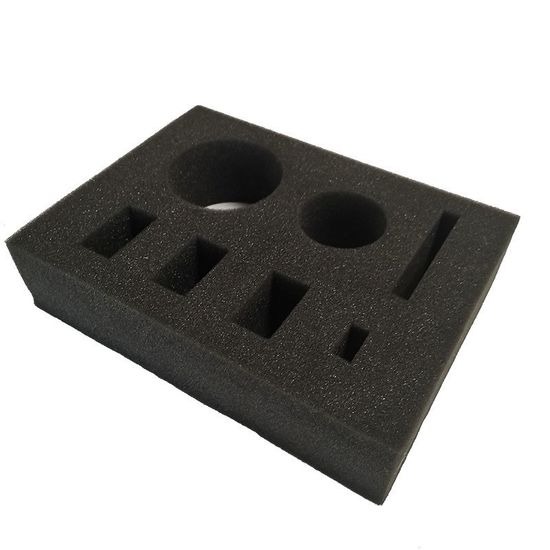
Open cell polyurethane foam is a flexible cellular material containing an interconnected network of pores. Air can move through these pores rather than remaining trapped inside isolated cells.
This porous structure gives flexible PU foam its characteristic softness and makes it particularly useful for sound absorption, cushioning and airflow-related applications.
Unlike closed-cell foam, open-cell PU should not normally be selected as the primary water or water-vapor barrier. Its main advantages are acoustic absorption, resilience, cushioning, vibration damping and flexible conformability.
Foam density, thickness, compression behavior and cell structure should be selected according to the finished application.
Open Cell PU Foam for Sound Absorption
Open cell polyurethane foam is widely used in acoustic applications because airborne sound can enter the interconnected pore structure.
As sound waves travel through the foam, part of their energy can be dissipated inside the cellular structure. This helps reduce reflected sound and reverberation in suitable assemblies.
Typical uses include machinery enclosures, equipment housings, vehicle components, HVAC acoustic parts and other technical installations where sound absorption is required.
Actual acoustic performance depends on foam thickness, density, cell structure, surface treatment, installation method and sound frequency. Provide the noise source and available installation space when selecting foam for an acoustic project.
Polyurethane Foam for Machinery and Equipment Enclosures
Machinery and technical equipment can generate airborne noise, resonance and vibration inside covers and housings. Open cell PU foam can be installed on suitable internal surfaces to provide acoustic absorption and cushioning.
Typical applications include motor housings, machinery covers, equipment cabinets, compressors, generators and other industrial enclosures where flexible acoustic foam can be incorporated into the internal assembly.
Adhesive backing or suitable facing materials can be evaluated when the foam needs to be positioned on vertical or internal equipment surfaces.
Open Cell PU Foam for Automotive NVH
Flexible open cell polyurethane foam can be used in selected automotive noise, vibration and harshness applications where sound absorption, cushioning or anti-rattle performance is required.
Potential applications include suitable interior trim areas, equipment housings, acoustic pads, vibration-control interfaces and components designed to reduce buzz, squeak and rattle.
For automotive projects, provide the required material standard, operating environment, density, thickness and acoustic or compression requirement for evaluation.
PU Foam for Protective Packaging and Case Inserts
Open cell polyurethane foam provides soft cushioning around instruments, electronics, equipment and other products during storage and transportation.
The foam can deform around the product and absorb part of the mechanical energy generated during impact or vibration. This makes it suitable for protective packaging, case liners, equipment inserts and cushioning pads.
For packaging projects, density and thickness should be selected according to product weight, fragility, cavity dimensions and expected handling conditions.
Open Cell PU Foam for Cushioning and Shock Absorption
Flexible PU foam can compress under load and recover after suitable deformation, providing a cushioning interface between components.
The referenced technical grade records a ball-rebound resilience result of 33.95% and provides measured compression-force values at 25%, 40% and 65% compression.
These properties can be considered when selecting foam for packaging inserts, pads, equipment mounts and other cushioning applications.
Open Cell PU Foam for Vibration Damping
PU foam can be positioned between components to reduce direct mechanical contact and provide a flexible vibration-damping layer.
Typical applications include equipment pads, enclosure liners, component mounts, packaging systems and selected automotive assemblies.
Vibration performance depends on foam density, compression, thickness, load and vibration frequency, so these parameters should be considered together.
Open Cell PU Foam for Airflow and Filtration Components
The interconnected pores in open cell polyurethane foam allow air to pass through the material, making suitable foam grades useful for airflow-related components and selected filtration applications.
Filtration performance depends strongly on pore structure, pore size, foam formulation and required airflow. These parameters should be specifically confirmed for filtration projects rather than assuming that every open cell PU grade provides the same filtration performance.
Typical Open Cell Polyurethane Foam Applications
| Application | Typical Function |
| Acoustic Panels and Liners | Sound absorption and reduction of reflected noise. |
| Machinery Enclosures | Internal sound absorption and vibration-control components. |
| Equipment Housings | Acoustic lining, cushioning and component isolation. |
| Automotive NVH | Sound absorption, anti-rattle cushioning and vibration damping. |
| Protective Packaging | Soft cushioning and impact protection around products. |
| Case Inserts | Custom cushioning for instruments, electronics and equipment. |
| Equipment Pads | Shock absorption and vibration damping between components. |
| Airflow Components | Air-permeable foam parts where the selected pore structure is suitable. |
| Filtration Components | Selected filtering applications using specifically evaluated PU foam grades. |
Open Cell vs. Closed Cell Polyurethane Foam
| Comparison | Open Cell PU Foam | Closed Cell PU Foam |
| Cell Structure | Interconnected pores | Predominantly isolated cells |
| Air Permeability | Air can move through suitable open-cell structures | Much lower air permeability |
| Sound Absorption | Well suited to selected acoustic absorption applications | Generally less suitable for porous sound absorption |
| Compression | Generally softer and more compressible depending on grade | Generally firmer depending on formulation |
| Moisture Barrier | Not normally selected as the primary moisture barrier | More suitable where reduced moisture penetration is required |
| Typical Uses | Acoustic, packaging, cushioning, filtration and NVH | Thermal insulation, rigid structural insulation and moisture-resistant applications |
PU Foam Sheets, Rolls, Strips and Custom Parts
| Product Form | Typical Use |
| PU Foam Sheet | General acoustic, cushioning and industrial fabrication. |
| PU Foam Roll | Continuous material for slitting, lamination and converting. |
| PU Foam Strip | Cushioning, spacing and vibration-control applications. |
| PU Foam Block | Base material for slicing and custom fabrication. |
| Packaging Insert | Custom cavities and cushioning around products. |
| Acoustic Pad | Sound absorption inside machinery and equipment enclosures. |
| Adhesive-Backed PU Foam | Helps position foam on suitable equipment, panel and enclosure surfaces. |
| Die-Cut PU Foam Part | Repeatable custom pads, inserts and industrial components. |
How to Select Open Cell Polyurethane Foam
Application: identify whether the foam is required for acoustic absorption, packaging, cushioning, NVH, vibration damping or airflow.
Density: specify the required density or desired softness and compression behavior.
Thickness: select according to acoustic, cushioning or available installation-space requirements.
Compression: provide the expected load and required compression where relevant.
Acoustic requirement: provide the noise source, available installation area and frequency range where known.
Packaging requirement: provide product dimensions, weight and required protection level.
Airflow or filtration requirement: provide the required airflow or pore characteristics if the foam will be used as a functional air-permeable component.
Facing material: specify whether film, fabric or another surface layer is required.
Adhesive backing: identify whether self-adhesive foam is required for installation.
Finished form: sheet, roll, strip, block, pad, insert or die-cut component.
Project standard: provide any required flame, automotive or industrial specification.
Estimated quantity: provide sample, trial and production requirements where available.
Topsun PU Foam Processing Capabilities
Topsun supplies foam materials together with custom converting services according to customer dimensions, drawings and finished component requirements.
1. Cutting: PU foam sheets, rolls and blocks can be cut according to customer dimensions.
2. Slicing: foam materials can be sliced to the required thickness.
3. Lamination: hot-melt film lamination, flame lamination and pressure-sensitive adhesive lamination are available.
4. Laser Cutting: suitable custom foam shapes can be processed according to digital drawings.
5. Die Cutting: custom pads, inserts, strips and repeatable foam components can be manufactured according to customer drawings.
6. Compression Molding: three-dimensional molded foam and foam composite components can be produced for suitable applications.
7. Engraving: suitable for tool box inserts, packaging inserts and custom cavity components.
8. Silk-Screen Printing: logos and patterns can be printed on suitable foam surfaces.
9. Adhesive Backing: adhesive and release liner can be applied to suitable PU foam for strips, pads, acoustic parts and other converted products.
Other Foam Materials Available from Topsun
Topsun supplies PU foam, EVA foam, PE foam, XPE foam, IXPE foam, CR foam, EPDM foam, neoprene foam, SBR foam, NBR foam, NBR/PVC foam and micro-cell soft PVC foam in sheet, roll, block and custom converted forms.
About Topsun Foam
Topsun supplies foam materials and custom converted foam components for acoustic, packaging, automotive, equipment and industrial applications. Customers can provide density, thickness, compression requirements, acoustic requirements, drawings and finished dimensions for product evaluation.
Our facility is located in Changzhou City, Jiangsu Province, China, with convenient access to Shanghai Port for international shipments.
Open Cell Polyurethane Foam FAQ
What is open cell polyurethane foam?
Open cell polyurethane foam is a flexible cellular material with interconnected pores that allow air and sound waves to pass into the foam. It is commonly used for acoustic absorption, cushioning, packaging and vibration-control applications.
What is open cell PU foam used for?
Typical applications include acoustic liners, machinery enclosures, equipment housings, automotive NVH components, protective packaging, case inserts, cushioning pads and selected airflow or filtration parts.
Is open cell polyurethane foam good for sound absorption?
Yes. The interconnected pores allow sound waves to enter the material, where part of the acoustic energy can be dissipated. Actual performance depends on thickness, density, cell structure, installation and sound frequency.
What densities of open cell PU foam are available?
Topsun's current product information lists density options of 22, 25, 28 and 30 kg/m³. The referenced tested grade has a density specification of 23±2 kg/m³ and a recorded result of 22.42 kg/m³.
What is the resilience of the referenced PU foam?
The referenced technical specification lists ball-rebound resilience of ≥30% according to GB/T 6670-2008, with a recorded result of 33.95%.
What is the tensile strength?
The referenced PU foam grade lists tensile strength of ≥90 kPa according to GB/T 6344-2008, with a recorded test result of 108.24 kPa.
What is the elongation at break?
The technical table lists elongation at break of ≥100%, with a recorded result of 122.42% according to GB/T 6344-2008.
What compression-force data is available?
The referenced grade records compression-force results of 136.43 N at 25% compression, 169.58 N at 40% compression and 329.84 N at 65% compression according to GB/T 10807-2006.
Is open cell polyurethane foam waterproof?
Open-cell foam is air permeable and should not normally be selected as the primary water or water-vapor barrier. If moisture resistance is the main requirement, a suitable closed-cell foam should be evaluated.
Is open cell PU foam suitable for protective packaging?
Yes. Its soft cushioning and compression properties make open cell PU foam suitable for many protective packaging and case-insert applications. Density and thickness should be selected according to product weight and required protection.
Can open cell polyurethane foam be used in automotive applications?
It can be used for suitable automotive acoustic, NVH, cushioning and anti-rattle components where the selected PU foam grade meets the project requirements.
Can open cell PU foam be used for filtration?
Certain open cell polyurethane foam grades can be used for filtration because air can pass through their interconnected pore structure. Pore size and airflow performance must be specifically evaluated for the filtration application.
Can adhesive backing be added to PU foam?
Yes. Topsun provides pressure-sensitive adhesive lamination for suitable PU foam sheets, strips, pads and custom parts. The bonding substrate and service conditions should be provided for evaluation.
Can Topsun cut custom polyurethane foam parts?
Yes. Topsun provides cutting, slicing, lamination and die-cutting capabilities for suitable PU foam materials. Custom pads, inserts, strips and shaped components can be evaluated according to drawings.
What information should I provide for an acoustic foam project?
Please provide the noise source, frequency range if known, installation area, available thickness, required density, mounting method, facing requirement, adhesive requirement and estimated quantity.
What information should I provide for protective packaging?
Please provide product dimensions, product weight, fragility, case or package dimensions, required foam thickness, cavity layout, density if known and estimated quantity.
How can I request an open cell PU foam sample?
Send your requirements to july@topsunfoam.com, including density, thickness, dimensions, application and estimated quantity for evaluation.

 English
 العربية
 Français
 Русский
 Español
 Português
 Deutsch
 italiano
 日本語
 한국어
 Nederlands
 Tiếng Việt
 ไทย
 Polski
 Türkçe
 ភាសាខ្មែរ
 Bahasa Melayu
 ဗမာစာ
 தமிழ்
 Filipino
 Bahasa Indonesia
 magyar
 Română
 Čeština
 қазақ
 Српски
 हिन्दी
 فارسی
 Kiswahili
 Norsk
 Svenska
 українська
 Ελληνικά
 Suomi
 עברית
 Latine
 Dansk
 اردو
 বাংলা
 Afrikaans
 नेपाली
 Oʻzbekcha
 Azərbaycan dili
 Български
 guarani
 Hausa
 Kurdî
 Kurdî
 Lietuvių
 Wikang Tagalog
 isiZulu


