English


pu foam
Topsun
22, 25, 28, 30kgs/M3
30*30mm


Product Description
Topsun flexible polyurethane foam, also known as PU foam, is a lightweight and resilient cushioning material for automotive seating, furniture, bedding, protective packaging, case inserts, medical cushioning, electronics protection and other industrial applications.
The current flexible PU foam range includes densities of 22, 25, 28 and 30 kg/m³. Different densities and foam constructions can provide different levels of softness, support, compression response and resilience according to the finished product.
PU foam can be supplied as sheets, blocks, pads, inserts and custom converted components. Topsun also provides cutting, slicing, lamination, die cutting, engraving and adhesive backing according to customer drawings and application requirements.
Low-density options: current product information lists 22, 25, 28 and 30 kg/m³ grades.
Flexible cushioning: compressible foam provides soft support for seating, packaging and protective components.
Resilience: flexible PU foam can recover after suitable compression and repeated loading.
Shock absorption: suitable for protecting products and components from impact during handling and use.
Vibration damping: flexible foam can reduce direct mechanical contact and vibration transmission in suitable assemblies.
Lightweight: provides cushioning and support without adding substantial weight.
Surface protection: soft foam can help protect sensitive products against direct contact and abrasion.
Custom fabrication: foam can be cut, sliced, laminated, die-cut, engraved and converted into finished components.
Adhesive backing: suitable foam sheets, strips and pads can be supplied with pressure-sensitive adhesive.
| Item | Product Information |
| Material | Flexible Polyurethane Foam / PU Foam |
| Current Density Options | 22, 25, 28 and 30 kg/m³ |
| Referenced Tested Grade | 23±2 kg/m³ |
| Referenced Tensile Strength | ≥90 kPa |
| Referenced Elongation at Break | ≥100% |
| Available Forms | Sheet, Block, Pad, Insert and Custom Converted Parts |
| Typical Applications | Automotive, Furniture, Bedding, Packaging, Medical Cushioning, Electronics and Industrial Components |
| Processing | Cutting, Slicing, Lamination, Laser Cutting, Die Cutting, Engraving and Adhesive Backing |
The following technical data applies to the referenced flexible polyurethane foam grade. Final properties should be confirmed according to the selected density, formulation, thickness and finished application.
| Testing Item | Unit / Condition | Test Method / Reference | Specification | Test Result |
| Density | kg/m³ | GB/T 6343-2009 | 23±2 | 22.42 |
| Resilience / Ball Rebound | % | GB/T 6670-2008 | ≥30 | 33.95 |
| Hardness | Shore C | LX-F | ≥70 | 82 |
| Elongation at Break | % | GB/T 6344-2008 | ≥100 | 122.42 |
| Tear Strength | N/m | GB 10808-1989 | ≥400 | 651.5 |
| Tensile Strength | kPa | GB/T 6344-2008 | ≥90 | 108.24 |
| Compression Force | 25% Compression / N | GB/T 10807-2006 | ≥100 | 136.43 |
| 40% Compression / N | ≥130 | 169.58 | ||
| 65% Compression / N | ≥200 | 329.84 | ||
| Smoke Density | % | GB/T 8323.1-2008 | ≤30 | 5.77 |
| Oxygen Index | — | GB/T 2406-93 | ≥20 | 21.1 |
| Horizontal Combustion Rate | mm/min | GB 8410-2006 | ≤100 | A-0 |
Where a project requires a specific fire-performance, automotive, medical or other industry standard, provide the applicable specification so the appropriate foam grade and supporting documentation can be evaluated.
Flexible polyurethane foam is a cellular polymer material engineered to compress under load and recover after the load is removed. Different formulations can provide different combinations of softness, firmness, resilience, density and support.
Flexible PU foam is commonly produced as large foam blocks or buns that can then be sliced, cut, laminated or converted into sheets, cushions, inserts, pads and shaped components.
Unlike rigid polyurethane foam used primarily for structural thermal insulation, the PU foam on this page is a flexible low-density material intended mainly for cushioning, support, impact protection and related industrial applications.
Density and firmness are separate properties. Density describes the mass of foam per unit volume, while compression response describes how much force is required to compress the foam.
Two polyurethane foams with similar densities can have different compression characteristics depending on formulation and cell structure. For this reason, buyers should consider density together with compression force, resilience, thickness and expected load.
The referenced technical grade provides compression-force results at 25%, 40% and 65% compression, allowing its load response to be evaluated in addition to density.
Flexible polyurethane foam is widely used in vehicle seating and interior cushioning because it combines lightweight construction, resilience and adaptable compression performance.
Suitable applications can include seat cushioning, headrests, armrests, interior padding, trim interfaces and selected acoustic or vibration-control components.
Automotive projects should specify density, firmness, component dimensions, operating environment and any required material or combustion standard.
Flexible PU foam is commonly used for cushions, upholstered furniture, mattresses, backrests and other comfort applications requiring a balance of softness, support and resilience.
Different foam densities and compression characteristics can be selected according to the required comfort level, load and expected frequency of use.
Flexible polyurethane foam can provide soft cushioning for electronics, instruments, equipment and other products that need protection from shock and vibration during storage and transportation.
Foam sheets, pads and case inserts can be cut to follow product geometry and provide controlled cushioning around sensitive surfaces.
Packaging foam should be selected according to product weight, fragility, available cushioning space, expected drop or vibration conditions and the number of anticipated handling cycles.
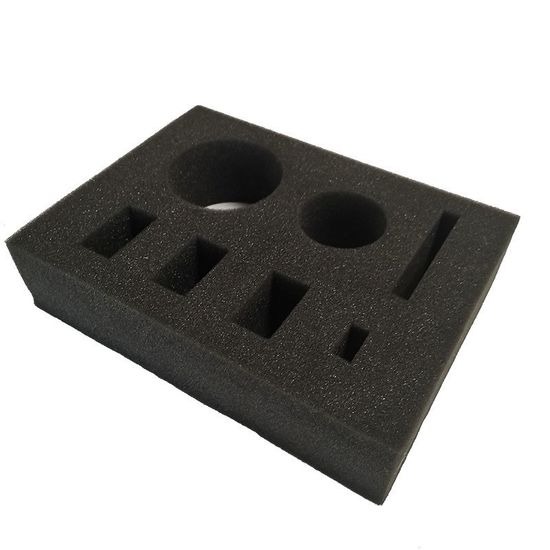
Custom-cut polyurethane foam can be used inside cases and containers to cushion instruments, electronics and equipment.
Cavities and profiles can be fabricated according to product dimensions so that individual components remain separated and supported during transport.
For custom case inserts, provide the case dimensions, product dimensions, product weight, required foam depth and cavity layout.
Flexible polyurethane foam can be used in suitable cushioning and positioning products where softness, pressure distribution and support are required.
Potential applications include cushions, positioning supports, padding and other converted foam components. Applications with medical or healthcare requirements should specify the relevant material, cleanliness and regulatory requirements for evaluation.
Electronics and instruments may require soft cushioning to reduce direct impact and movement inside cases, packaging or assemblies.
Flexible PU foam can be cut into pads, inserts and protective shapes according to the available space and product geometry.
Where electrical conductivity, static dissipation or another specialized electrical property is required, the required material specification should be provided for evaluation.
Flexible PU foam can be installed between components as a cushioning layer to reduce direct mechanical contact.
Pads and strips can be used in suitable equipment, housings, assemblies and packaging systems where impact absorption, vibration damping or soft spacing is required.
Final performance depends on foam density, thickness, compression, supported load and the vibration or impact conditions of the application.
| Application | Typical Function |
| Automotive Seating | Comfort cushioning and resilient support. |
| Headrests and Armrests | Soft padding and ergonomic support. |
| Furniture Cushions | Comfort, support and repeated compression recovery. |
| Mattresses and Bedding | Cushioning and pressure distribution. |
| Protective Packaging | Shock and vibration cushioning during handling and shipping. |
| Case Inserts | Custom cushioning and positioning for instruments and equipment. |
| Medical Cushioning | Padding and support in suitable healthcare-related products. |
| Electronics Protection | Soft cushioning for sensitive electronic and technical components. |
| Industrial Pads | Cushioning, spacing and vibration-control interfaces. |
| Comparison | Flexible PU Foam | Rigid PU Foam |
| Primary Function | Cushioning, support and impact absorption | Structural thermal insulation |
| Compression | Flexible and compressible | Much firmer and structurally rigid |
| Typical Applications | Seating, bedding, packaging, inserts and cushioning | Building panels, refrigeration insulation and rigid insulated structures |
| Current Topsun Product on This Page | 22–30 kg/m³ flexible PU foam | Not represented by the technical data on this page |
| Product Form | Typical Application |
| PU Foam Sheet | General cushioning, padding and downstream fabrication. |
| PU Foam Block | Base material for slicing and custom converting. |
| Packaging Insert | Cushioning around instruments, electronics and equipment. |
| PU Foam Pad | Cushioning, shock absorption and vibration-control applications. |
| Die-Cut Part | Repeatable custom components according to drawings. |
| Adhesive-Backed Foam | Helps position suitable pads and strips during assembly. |
| Laminated Foam | Composite foam construction for suitable finished-product requirements. |
Application: seating, bedding, packaging, case insert, medical cushioning or industrial component.
Density: specify the required density or select from the available 22, 25, 28 and 30 kg/m³ options.
Firmness: provide the desired softness, support or compression requirement.
Thickness: specify the available installation or cushioning depth.
Load: provide the expected weight or compression load applied to the foam.
Resilience: identify whether repeated compression and recovery are important to the application.
Product dimensions: provide dimensions or drawings for custom inserts and converted parts.
Adhesive requirement: specify whether plain foam or adhesive-backed foam is required.
Lamination: identify whether another foam, fabric, film or facing needs to be laminated to the PU foam.
Industry standard: provide any required automotive, fire-performance, medical or other material specification.
Finished form: sheet, block, pad, insert or custom die-cut component.
Estimated quantity: provide sample, trial and production requirements where available.
Topsun supplies foam materials together with custom converting according to customer dimensions, drawings and finished component requirements.
1. Cutting: PU foam sheets and blocks can be cut according to customer dimensions.
2. Slicing: foam blocks can be sliced to the required finished thickness.
3. Lamination: hot-melt film lamination, flame lamination and pressure-sensitive adhesive lamination are available.
4. Laser Cutting: suitable foam shapes can be processed according to digital drawings.
5. Die Cutting: custom pads, inserts and repeatable components can be produced according to customer designs.
6. Compression Molding: three-dimensional molded foam and foam composite components can be evaluated for suitable applications.
7. Engraving: suitable foam materials can be processed for tool box inserts, packaging inserts and shaped cavities.
8. Silk-Screen Printing: logos and patterns can be printed on suitable foam surfaces.
9. Adhesive Backing: adhesive and release liner can be applied to suitable foam sheets, strips, pads and custom parts.
Topsun supplies PU foam, EVA foam, PE foam, XPE foam, IXPE foam, CR foam, EPDM foam, neoprene foam, SBR foam, NBR foam, NBR/PVC foam and micro-cell soft PVC foam in sheet, roll and custom converted forms.
Topsun supplies polyurethane foam and other foam materials for automotive, furniture, bedding, packaging, electronics, medical cushioning and industrial applications. Custom converted foam components can be evaluated according to drawings, dimensions and performance requirements.
Our facility is located in Changzhou City, Jiangsu Province, China, with convenient access to Shanghai Port for international shipments.


Flexible polyurethane foam is a lightweight cellular material designed to compress under load and recover afterward. It is widely used for cushioning, seating, bedding, packaging and industrial components.
The current product information lists flexible PU foam density options of 22, 25, 28 and 30 kg/m³.
The referenced technical grade has a density specification of 23±2 kg/m³ according to GB/T 6343-2009, with a recorded test result of 22.42 kg/m³.
The referenced grade lists ball-rebound resilience of ≥30% according to GB/T 6670-2008, with a recorded result of 33.95%.
The referenced specification lists tensile strength of ≥90 kPa according to GB/T 6344-2008, with a recorded result of 108.24 kPa.
The referenced PU foam grade lists elongation at break of ≥100%, with a recorded result of 122.42%.
The referenced grade records compression-force values of 136.43 N at 25% compression, 169.58 N at 40% compression and 329.84 N at 65% compression according to GB/T 10807-2006.
No. Density describes mass per unit volume, while firmness describes how much force is required to compress the foam. Both properties should be considered when selecting flexible PU foam.
Typical applications include automotive seating, headrests, armrests, furniture cushions, bedding, packaging inserts, medical cushioning, electronics protection and industrial pads.
Yes. Flexible PU foam can provide soft cushioning and shock absorption for suitable instruments, electronics and other products during handling and transportation.
Yes. Suitable PU foam can be cut, engraved or die-cut into protective inserts according to case and product dimensions.
Flexible PU foam is compressible and commonly used for cushioning, seating and packaging. Rigid polyurethane foam is much firmer and is primarily used for structural thermal insulation. The product on this page is flexible low-density PU foam.
Yes. Pressure-sensitive adhesive backing can be applied to suitable PU foam sheets, pads and strips. Provide the bonding substrate and service environment for evaluation.
Yes. Topsun provides cutting, slicing, lamination, laser cutting, die cutting and engraving for suitable polyurethane foam products.
Please provide the application, density, desired firmness, thickness, dimensions, load or cushioning requirement, adhesive or lamination requirement, drawings, applicable material standard and estimated quantity.
Send your requirements to july@topsunfoam.com, including density, thickness, dimensions, application and estimated quantity for evaluation.