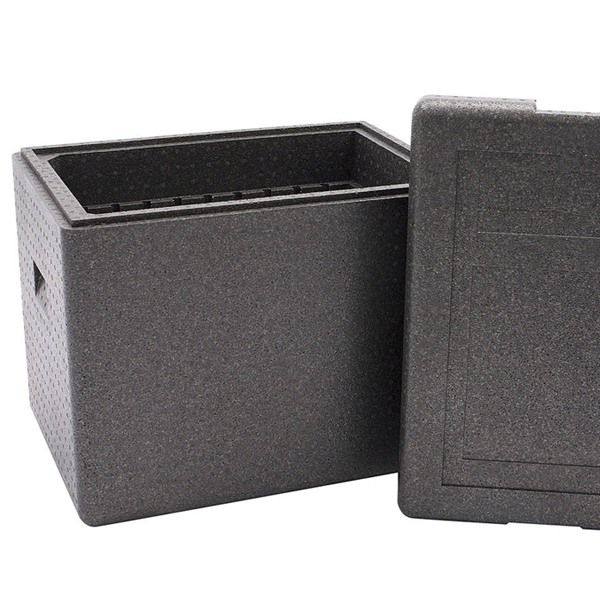
epp foam
Topsun
45kg/M3
490*380*400


Product Description
Topsun EPP foam ice box is a lightweight, reusable insulated container for seafood, meat, frozen food, fresh produce, beverages, meal delivery and other temperature-sensitive products requiring protected transport or temporary cold storage.
The current product uses Expanded Polypropylene foam with a published density of 45 kg/m³ and product size of 490×380×400 mm. Its molded closed-cell structure combines thermal insulation, impact protection, low water absorption and low transport weight.
The EPP ice box can be used with ice packs, gel packs or other appropriate cooling media according to the target temperature and route conditions. Topsun can also evaluate custom box dimensions, wall thickness, density, lid structure, handles, internal partitions, inserts, color and branding for OEM cold-chain projects.
| Item | Product Information |
| Product Name | EPP Foam Ice Box / EPP Cold Storage Box |
| Material | Expanded Polypropylene Foam / EPP |
| Published Density | 45 kg/m³ |
| Published Product Size | 490×380×400 mm |
| Main Function | Thermal Insulation, Impact Protection and Reusable Transport |
| Primary Applications | Seafood, Meat, Frozen Food, Fresh Produce, Food Delivery and Cold Chain Logistics |
| Other Applications | Pharmaceutical and Biological Sample Transport as Part of an Appropriate Validated Packout |
| Customization | Size, Shape, Density, Wall Thickness, Lid, Handle, Inner Structure, Color and Logo |
Thermal insulation: the closed-cell EPP structure helps slow heat transfer between the contents and external environment.
Impact protection: molded EPP absorbs shocks during loading, unloading and transportation.
Lightweight construction: the foam provides insulation and protection without adding excessive transport weight.
Low water absorption: EPP is suitable for transport environments involving condensation, moisture and cold packs.
Reusable structure: suitable boxes can be used through repeated logistics cycles under appropriate handling conditions.
Protective molded walls: the box helps protect packaged products against direct mechanical impact.
Custom internal layout: partitions, inserts and coolant positions can be developed according to the payload.
Custom molded design: alternative size, density, wall thickness, lid and carrying structures can be evaluated for OEM projects.
Polypropylene-based material: EPP can be recycled where suitable collection and polypropylene recycling facilities are available.
The current product specification image is retained below. For purchasing and cold-chain planning, buyers should also confirm the required internal usable dimensions, payload volume, wall thickness and coolant space before placing an order.

Seafood distribution often involves chilled products, melting ice, condensation and frequent handling. An EPP ice box provides an insulated and impact-resistant outer container for suitable packaged fish, shellfish and other seafood products.
The box can be used with suitable ice packs, gel packs or other cooling arrangements according to the seafood product, required temperature and delivery duration.
Buyers should provide package dimensions, total seafood weight, starting product temperature, target transport temperature and route duration when evaluating the box and coolant layout.
EPP insulated boxes can be used for suitable packaged meat, chilled prepared food, dairy products and other products that require insulated handling during distribution.
Internal dimensions should be matched to the package dimensions while leaving sufficient space for any required cooling media. Excessive empty space can make product positioning and temperature management less efficient.
For commercial cold-chain projects, the finished packout should be tested under representative loading and ambient conditions.
Frozen-food transport places a higher thermal demand on the complete packaging system than ordinary chilled delivery.
EPP can provide the insulated outer box, but the required coolant system, product preconditioning, loading method and transport profile must be selected according to the target temperature.
Topsun does not assign one universal frozen holding time to the box because actual performance varies with the complete packout and environmental conditions.
Fresh fruit, vegetables and other produce may require insulated protection during warehouse transfer, distribution and last-mile delivery.
A reusable EPP box can help protect packed produce against direct impacts while reducing heat transfer during transportation.
Product ventilation requirements, humidity sensitivity and the appropriate temperature range should be considered when planning the complete produce transport system.
EPP insulated containers can be used in professional meal delivery, central kitchen distribution, catering and branch replenishment systems.
The low container weight helps with repeated handling, while the molded foam structure provides insulation and impact protection during vehicle transport and multi-stop delivery.
Buyers should consider the package format, number of units per box, delivery duration, frequency of lid opening and whether chilled or frozen coolant is required.
EPP ice boxes can also be evaluated as the insulated container in passive packaging systems for pharmaceuticals, vaccines, diagnostic products, laboratory materials and biological samples.
The EPP container alone does not establish a validated temperature range or holding time. Temperature-sensitive medical shipments should use a qualified packout incorporating the intended payload, coolant configuration, temperature monitoring, ambient profile and transportation duration.
Customers with regulated cold-chain applications should provide the required temperature range and applicable packaging validation requirements for project evaluation.
| Comparison | EPP Ice Box | Active Refrigeration |
| Cooling Method | Passive insulation with suitable coolant where required | Powered refrigeration system |
| Power Supply | No electrical power required for the box itself | Requires an energy source |
| Typical Use | Transport, delivery and temporary insulated storage | Longer-term controlled refrigeration |
| Temperature Performance | Depends on insulation, payload, coolant and ambient conditions | Controlled by the refrigeration equipment and operating settings |
| Step | Information to Confirm |
| 1. Product Type | Seafood, meat, frozen food, produce, beverage, pharmaceutical or other payload. |
| 2. Payload Size | Package dimensions, quantity per box and total loaded weight. |
| 3. Target Temperature | Required transport temperature range and starting product temperature. |
| 4. Coolant | Ice packs, gel packs or another suitable cooling medium, including quantity and conditioning. |
| 5. Coolant Position | Location around or between the payload according to the required temperature profile. |
| 6. Route | Total transport duration, vehicle conditions and number of delivery stops. |
| 7. Ambient Conditions | Expected external temperature during storage and transport. |
| 8. Validation | Test the complete packout under representative conditions where temperature compliance is important. |
One EPP ice box does not have a universal holding time for every product or route. Temperature performance depends on the complete combination of packaging and operating conditions.
| Factor | Why It Matters |
| Wall Thickness | Influences heat transfer through the insulated box structure. |
| Internal Volume | Affects payload loading, coolant quantity and unused air space. |
| Payload Mass | Changes the thermal mass of the complete packout. |
| Starting Temperature | Products loaded warmer or colder than required change the thermal demand. |
| Coolant Type | Different cooling media provide different temperature behavior. |
| Coolant Quantity | The quantity contributes to the available cooling capacity. |
| Coolant Layout | Placement affects temperature distribution around the products. |
| Ambient Temperature | Higher external temperatures increase the thermal load. |
| Transport Time | Longer journeys require temperature control for a longer period. |
| Lid Opening | Repeated opening introduces external air and can accelerate temperature change. |
| Application | Typical Requirement |
| Seafood Transport | Insulated transport involving moisture, chilled products and repeated handling. |
| Meat Distribution | Cold-chain delivery of appropriately packaged chilled meat products. |
| Frozen Food | Insulated outer container combined with an appropriate low-temperature packout. |
| Fresh Produce | Impact protection and reduced temperature fluctuation during distribution. |
| Food Delivery | Reusable insulated transport for suitable chilled or temperature-sensitive food packages. |
| Beverage Distribution | Insulated handling and impact protection for suitable packaged beverages. |
| Pharmaceutical Logistics | Use as part of a qualified temperature-controlled packaging system. |
| Biological Samples | Protected transport under defined and validated temperature conditions. |
EPP is well suited to returnable logistics systems where containers are repeatedly loaded, delivered, collected and reused.
Typical closed-loop applications include warehouse-to-store distribution, central kitchen delivery, seafood distribution networks, laboratory routes and inter-site cold-chain transport.
Boxes should be inspected between cycles for cracks, deformation, damaged corners or lid-fit changes that could affect mechanical protection or insulation performance.
Topsun can evaluate custom EPP ice boxes when the standard 490×380×400 mm product does not match the payload, cooling system or transport workflow.
| Customization Item | Project Consideration |
| Outer Dimensions | Vehicle, shelf, pallet and warehouse handling limitations. |
| Inner Dimensions | Payload package size, loading quantity and coolant space. |
| Wall Thickness | Required balance between usable volume, insulation and structural protection. |
| EPP Density | Selected according to box weight, structural and impact requirements. |
| Lid Structure | Opening frequency, alignment, handling and thermal requirements. |
| Coolant Position | Dedicated areas for ice packs, gel packs or other cooling media. |
| Internal Partitions | Separation of payloads and controlled placement of coolant. |
| Handles | Carrying requirements for warehouse and last-mile handling. |
| Stacking Structure | Warehouse, pallet and vehicle distribution requirements. |
| Color and Branding | Customer identification, logo and project-specific appearance requirements. |
Product type: seafood, meat, frozen food, produce, food delivery or other goods
Individual package dimensions
Quantity and total payload weight per box
Required inner or outer box dimensions
Required transport temperature range
Starting product temperature
Expected ambient temperature
Transport or holding duration
Ice pack, gel pack or other coolant requirement
Required coolant position or partition design
Stacking and carrying requirements
Reuse frequency
Color and logo requirement
Estimated order quantity
In addition to molded EPP boxes, Topsun supplies and processes foam materials for packaging, insulation, protection and industrial applications.
1. Cutting: foam sheets, blocks and suitable parts can be cut according to customer dimensions.
2. Slicing: foam materials can be sliced to the required thickness.
3. Lamination: hot-melt film, flame and pressure-sensitive adhesive lamination are available for suitable materials.
4. Laser Cutting: suitable foam shapes can be processed according to digital drawings.
5. Die Cutting: repeatable pads, seals and inserts can be manufactured according to customer designs.
6. Compression Molding: three-dimensional molded foam and foam composite components can be manufactured for suitable applications.
7. Engraving: suitable for tool box inserts, packaging inserts and custom foam cavities.
8. Silk-Screen Printing: logos and patterns can be printed on suitable foam surfaces.
9. Adhesive Backing: adhesive and release liner can be applied to suitable foam materials.
Topsun supplies molded EPP products together with EVA foam, PE foam, XPE foam, IXPE foam, CR foam, EPDM foam, neoprene foam, SBR foam, NBR foam and micro-cell soft PVC foam in sheet, roll, block and custom converted forms.
Topsun supplies molded EPP boxes and custom foam products for food distribution, cold chain logistics, reusable transport packaging and industrial applications. Customers can provide payload dimensions, temperature requirements, transport conditions, drawings or samples for product evaluation.
Our facility is located in Changzhou City, Jiangsu Province, China, with convenient access to Shanghai Port for international shipments.

An EPP foam ice box is a reusable passive insulated container made from Expanded Polypropylene foam. It is used for cold-chain transport, food delivery and temporary insulated storage of suitable temperature-sensitive products.
The current published product size is 490×380×400 mm.
The current published EPP density is 45 kg/m³.
Yes. EPP ice boxes can be used for suitably packaged seafood where insulation, impact protection and moisture-resistant handling are required. The required cooling arrangement depends on the seafood type and route conditions.
EPP insulated boxes can be used in suitable chilled-meat distribution systems. Product packaging, target temperature, coolant arrangement and transport duration should be defined for the complete cold-chain packout.
It can be used as the insulated outer container in a frozen-food packaging system. The required low-temperature coolant and packout should be selected and tested according to the target temperature and transport duration.
No. The EPP box is a passive insulated container and does not actively generate cooling. Temperature control normally depends on pre-conditioned products, appropriate coolant and the complete packaging configuration.
Many chilled and frozen applications require ice packs, gel packs or other cooling media. The appropriate type, quantity and placement depend on the required temperature and route duration.
There is no universal holding time. Performance depends on wall thickness, internal volume, payload quantity, starting temperature, coolant type and quantity, ambient temperature, transport duration and lid-opening frequency.
Yes. EPP has good impact resilience and is suitable for repeated transport applications. Boxes should be inspected between cycles for structural damage or changes in lid fit.
EPP has low water absorption, which makes it suitable for many cold-chain environments involving condensation, moisture and cooling packs.
EPP boxes can be evaluated as part of a passive temperature-controlled pharmaceutical packaging system. Regulated or temperature-critical shipments should use an appropriately qualified packout.
Yes. Custom projects can include box dimensions, density, wall thickness, lid structure, handles, internal partitions, inserts, coolant positions, color and logo according to project requirements.
Dedicated partitions or internal structures can be evaluated to control payload and coolant positioning according to the required packout.
EPP is polypropylene-based and can be recycled where appropriate polypropylene collection and processing systems are available.
Please provide the product type, package dimensions, quantity and weight per box, required box size, target temperature, starting temperature, route duration, ambient conditions, coolant arrangement, stacking requirement, customization requirements and estimated order quantity.
Send your requirements to july@topsunfoam.com, including box size, application, temperature requirement, coolant plan, customization requirement and estimated quantity for evaluation.