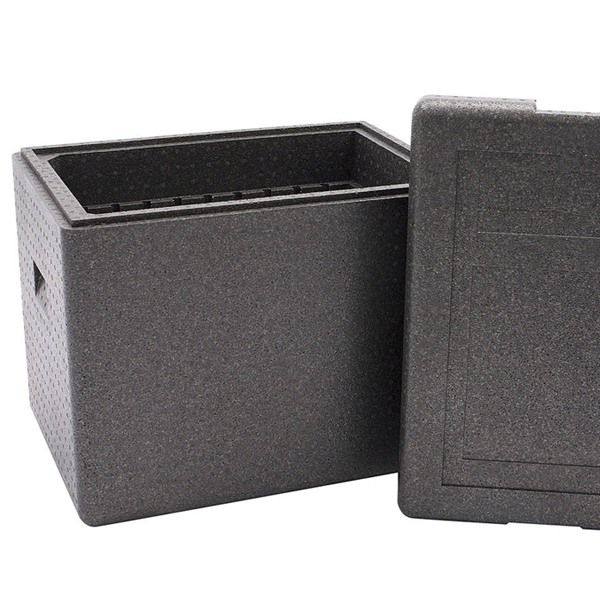
epp foam
Topsun
45kg/M3
500*440*400


Product Description
Topsun EPP insulated cold cooler box is a lightweight and reusable transport container designed for cold chain logistics, food delivery, fresh-product distribution, temperature-sensitive shipments and reusable supply-chain operations.
The current product uses Expanded Polypropylene foam with a published density of 45 kg/m³ and product size of 500×440×400 mm. The molded EPP structure combines thermal insulation, impact absorption, low weight and durability for repeated handling and transportation.
The box can be used with suitable ice packs, cold packs or other temperature-control components according to the payload and transport conditions. Custom molded EPP box projects can also be evaluated according to required dimensions, lid structure, internal layout and logistics application.
| Item | Product Information |
| Product | EPP Insulated Cold Cooler Box |
| Material | Expanded Polypropylene Foam / EPP |
| Published Density | 45 kg/m³ |
| Published Product Size | 500×440×400 mm |
| Main Functions | Thermal Insulation, Impact Protection and Reusable Transport |
| Typical Applications | Cold Chain, Food Delivery, Fresh Products, Temperature-Sensitive Goods and Reusable Logistics |
| Construction | Molded EPP Foam Box with Lid |
| Custom Development | Available for Evaluation According to Size, Payload, Structure and Application Requirements |
Thermal insulation: the EPP foam structure helps reduce heat transfer between the payload and surrounding environment.
Impact resistance: EPP absorbs shocks during loading, handling and transportation to help protect the contents.
Lightweight construction: low box weight supports repeated manual handling and route delivery.
Reusable design: molded EPP has good resilience and is suitable for repeated logistics cycles under appropriate use conditions.
Low water absorption: EPP is suitable for transport environments involving moisture, condensation and cold packs.
Protective structure: the molded box helps protect the payload against direct impact during transport.
45 kg/m³ EPP grade: the current product is supplied with a published density of 45 kg/m³.
Reusable logistics potential: suitable for evaluation in closed-loop delivery and returnable packaging systems.
Custom molded options: alternative dimensions, structures and internal layouts can be evaluated for OEM projects.
The following image contains the existing specification information for the EPP insulated cold cooler box. For purchasing or custom development, confirm the required payload dimensions, internal usable space, transport temperature, route duration and coolant arrangement.
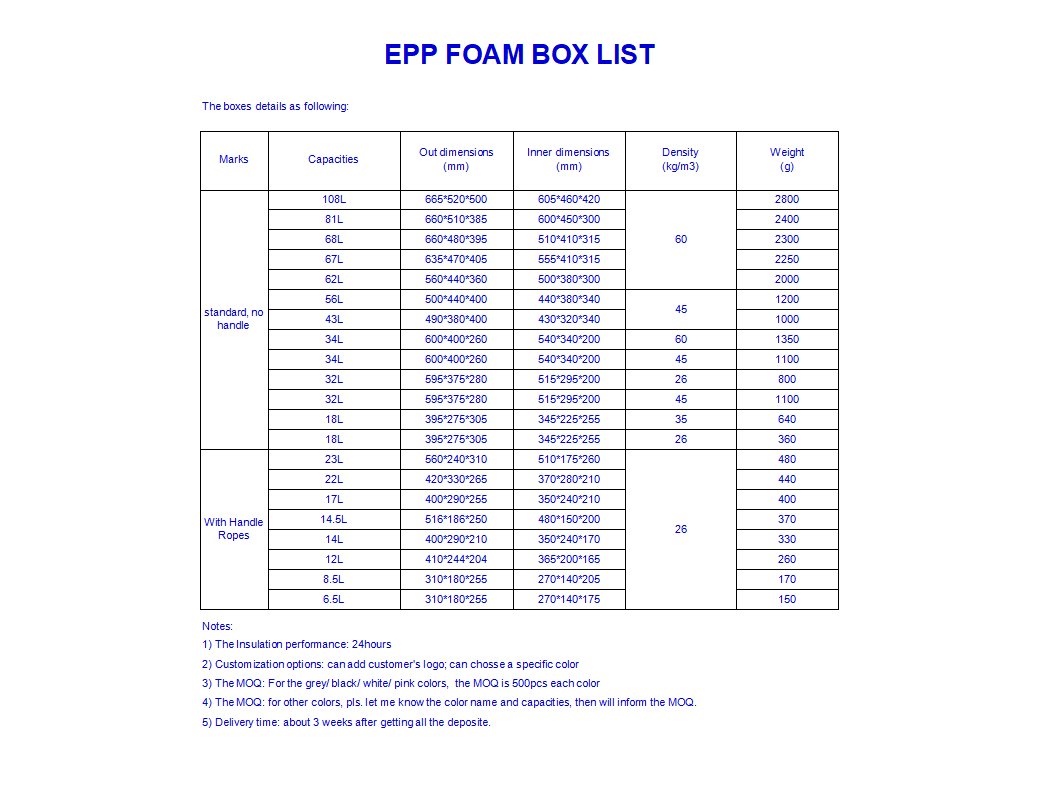
The current cooler box uses a published EPP density of 45 kg/m³. The density is one component of the finished box design and should be considered together with wall thickness, box geometry, lid structure and required mechanical performance.
For cold chain applications, the box can be combined with suitable coolant packs and internal arrangements according to the required temperature range and transport duration.
Buyers should provide the payload quantity, initial product temperature, target temperature range, expected ambient conditions and route time when evaluating the complete cold-chain packout.
Reusable EPP insulated boxes can be used for suitable prepared-food, catering, meal-distribution, bakery, beverage and fresh-product delivery systems.
Lightweight construction makes the container easier to handle during multi-stop delivery, while the insulated foam structure helps reduce temperature change during the distribution route.
Product pack dimensions, container loading pattern, delivery duration and whether the box is opened at multiple stops should all be considered when selecting the transport configuration.
EPP boxes can be evaluated for transporting fresh produce, beverages, dairy products, prepared meals and other goods requiring insulated distribution.
Cold packs or other cooling media can be positioned around the payload where required. Internal arrangement should provide sufficient space for both the goods and the selected coolant system.
For temperature-sensitive products, the final packout should be tested under representative transport and ambient conditions.
EPP insulated containers can be evaluated as one component of temperature-controlled packaging systems for pharmaceuticals, laboratory samples and other sensitive goods.
The EPP box alone does not define a validated temperature range or holding time. Performance depends on the complete packout, including the payload, coolant configuration, monitoring method, ambient profile and transport duration.
Projects requiring a defined temperature range should provide the applicable packaging qualification or validation requirements for evaluation.
EPP is particularly useful for distribution systems where containers are delivered, collected and reused through multiple logistics cycles.
Typical examples include central kitchens supplying stores, warehouse-to-branch distribution, food-service routes, laboratory networks and other closed-loop supply chains.
Reusable boxes should be inspected between cycles for lid fit, cracks, deformation and surface condition before returning them to service.
| Factor | Why It Matters |
| Wall Thickness | Affects the thermal path between the payload and external environment. |
| Box Geometry | Internal volume and surface area influence overall thermal behavior. |
| Lid Fit | The lid and mating structure affect air exchange around the container opening. |
| Payload Temperature | Starting product temperature affects the thermal load of the complete system. |
| Coolant Quantity | Cold packs or other coolant provide additional thermal capacity. |
| Coolant Position | Placement affects temperature distribution around the payload. |
| Ambient Temperature | Higher or lower external temperatures change the thermal load on the box. |
| Transport Duration | Longer routes require the complete packaging system to manage heat transfer for a longer period. |
| Lid Opening | Repeated opening can introduce external air and increase temperature fluctuation. |
| Step | Information to Confirm |
| 1. Define Payload | Product dimensions, quantity, total weight and loading orientation. |
| 2. Define Temperature | Required temperature range and starting product temperature. |
| 3. Define Route | Transport duration, ambient conditions and expected number of delivery stops. |
| 4. Select Coolant | Type, size, quantity and preconditioning of cold packs or other coolant. |
| 5. Plan Layout | Payload position, coolant location, dividers and unused internal space. |
| 6. Verify Performance | Test the complete packout under representative conditions where temperature performance is critical. |
| Application | Typical Requirement |
| Food Delivery | Reusable insulated transport for prepared food and meal distribution. |
| Cold Chain Logistics | Insulated transport with defined payload and coolant configuration. |
| Fresh Food Distribution | Transport of suitable fresh and chilled goods. |
| Catering Distribution | Repeated movement of prepared food between kitchens and service locations. |
| Pharmaceutical Transport | Temperature-controlled packaging system where the complete packout is appropriately validated. |
| Laboratory Samples | Protected transport under defined temperature and packaging conditions. |
| Returnable Logistics | Repeated distribution and collection within closed-loop networks. |
| Protective Transport | Impact protection for suitable instruments, electronics and industrial products. |
Where the standard 500×440×400 mm product does not match the required payload or logistics system, a custom molded EPP box can be evaluated.
| Design Requirement | Information to Provide |
| Box Dimensions | Required outer dimensions or available transport space. |
| Internal Space | Payload dimensions, quantity and coolant requirement. |
| Wall Structure | Thermal, structural and usable-volume requirements. |
| Lid Design | Opening frequency, handling and mating structure. |
| Internal Divider | Payload separation or coolant positioning requirements. |
| Stacking Requirement | Warehouse, vehicle, pallet and route handling conditions. |
| Identification | Required molded marks or other identification details. |
Payload type and application
Product dimensions and quantity per box
Required box dimensions if already defined
Payload weight
Required transport temperature range
Expected route duration
Ambient temperature conditions
Cold-pack or coolant arrangement
Divider or insert requirements
Stacking and handling method
Reuse frequency
Estimated quantity
Topsun provides molded EPP product development and foam converting support for insulated boxes, protective packaging and custom foam components.
Custom Molded EPP: three-dimensional EPP products can be evaluated according to drawings, samples and application requirements.
Custom Inserts: suitable foam inserts and positioning components can be produced according to payload geometry.
Cutting: suitable foam materials can be cut according to customer dimensions and internal packaging requirements.
Die Cutting: custom pads, inserts and repeatable foam components can be produced according to drawings.
Printing: suitable foam products can be evaluated for logos, identification marks and printed patterns.
Topsun supplies molded EPP products and foam materials for packaging, transportation, automotive and industrial applications. Customers can provide payload dimensions, box requirements, temperature conditions and drawings for product evaluation.
Our facility is located in Changzhou City, Jiangsu Province, China, with convenient access to Shanghai Port for international shipments.

An EPP insulated cold cooler box is a molded container made from Expanded Polypropylene foam. It combines thermal insulation, impact protection, lightweight handling and reusable construction for suitable transport applications.
The current published product size is 500×440×400 mm.
The current product uses a published EPP density of 45 kg/m³.
Suitable applications can include prepared food, fresh products, beverages, chilled goods, pharmaceuticals, laboratory samples and other products requiring insulated or protective transport.
There is no single holding time that applies to every shipment. Temperature retention depends on box construction, payload temperature, coolant quantity, ambient conditions, route duration and lid-opening frequency. Temperature-critical systems should be tested under representative conditions.
Many chilled transport systems use ice packs, cold packs or other coolant inside the insulated EPP box. The required coolant depends on the target temperature, payload and transport duration.
EPP has good impact resilience and is suitable for reusable transport systems. The box should be inspected between cycles and removed from service if damage affects the structure or lid fit.
EPP insulated containers can be used in suitable food-delivery and catering systems because they combine lightweight handling, insulation and impact protection. The finished transport configuration should match the food package and route conditions.
It can be evaluated as part of a temperature-controlled pharmaceutical packaging system. For regulated or temperature-critical shipments, the complete packout should be qualified according to the required temperature range and transport profile.
EPP has low water absorption, which makes it suitable for many applications involving condensation, moisture and reusable cold-chain handling.
EPP is an energy-absorbing foam material and can help protect suitable payloads from shocks and impacts during loading, handling and transport.
Custom molded EPP box projects can be evaluated according to payload dimensions, required box size, lid structure, internal layout, stacking method and application requirements.
Internal dividers, positioning components and custom inserts can be evaluated according to the payload and coolant arrangement.
EPP is a polypropylene-based foam and can be recycled where appropriate collection and recycling facilities are available.
Please provide the payload type, package dimensions, quantity per box, required box size, payload weight, target temperature, route duration, ambient conditions, coolant arrangement, stacking requirement, internal divider requirement and estimated order quantity.
Send your requirements to july@topsunfoam.com, including box dimensions, payload type, temperature requirement, transport duration and estimated quantity for evaluation.