


epp foam
Topsun
30g/l-110g/l
Customize


Product Description
Topsun provides custom EPP automotive component mold development for complex three-dimensional Expanded Polypropylene vehicle parts requiring integrated ribs, recesses, channels, cavities, locating features, mounting areas and other molded functional geometry.
Each tooling project is developed around the finished automotive component rather than selected as a universal standard mold. Important inputs include the 3D part geometry, critical dimensions, EPP density, installation position, functional requirements, mating surfaces and intended production equipment.
Topsun's existing automotive EPP component range covers finished-part densities from 30 g/L to 110 g/L. Customers can provide a 3D CAD model, 2D drawing, physical sample or detailed finished-part requirements for project evaluation.
An EPP automotive component mold is dedicated production tooling used to form Expanded Polypropylene beads into a defined three-dimensional vehicle component.
During particle foam molding, EPP beads are introduced into the mold cavity and fused under controlled processing conditions. The resulting component follows the geometry created by the tooling cavity.
This process makes it possible to create detailed automotive components with contours, ribs, support surfaces, cavities, channels, recesses, locating areas and other features directly in the molded part rather than relying only on secondary cutting or assembly.
Because each automotive component normally fits a specific vehicle position, the mold should be developed around the approved finished-part design, material requirement and intended production setup.
The values below describe Topsun's current molded EPP automotive component range. They are finished-part requirements used as inputs during tooling development and are not specifications of the mold construction itself.
| Item | Reference Requirement |
| Application | Automotive Components |
| Finished-Part Material | Expanded Polypropylene / EPP |
| Finished-Part Density | 30–110 g/L |
| Existing Product Color | Black |
| Component Size | Customized |
| Component Geometry | Customized According to Drawings, Samples and Vehicle Installation Requirements |
| Development Input | 3D CAD, 2D Drawing, Physical Sample or Detailed Finished-Part Requirements |
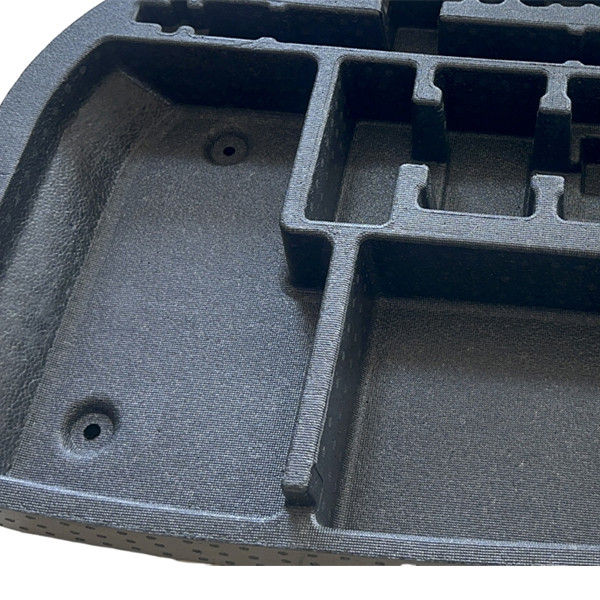
Complex automotive components should be reviewed from the finished part first. The part model defines the geometry that must ultimately be reproduced by the production tooling.
Important areas can include outer contours, wall sections, support ribs, deep recesses, cavities, cable channels, locating points, mounting areas, contact surfaces and other geometric features that interact with surrounding vehicle components.
Complex features should be identified before tooling is finalized because they can influence mold filling, part formation, component release and the production configuration required for the project.
EPP density should also be defined where possible because the selected material grade affects the finished component's weight and mechanical behavior and is an important input during molding evaluation.
| Geometric Feature | Typical Function | Project Review |
| Support Ribs | Local structural support and geometry reinforcement. | Review rib depth, spacing and surrounding wall sections. |
| Deep Recesses | Clearance for adjacent vehicle components. | Review moldability and component release. |
| Cavities | Storage, clearance or positioning of other components. | Review depth, access and surrounding geometry. |
| Channels | Routing or clearance for suitable vehicle systems. | Review channel width, depth and continuity. |
| Locating Features | Positioning the component during assembly. | Identify critical fit and reference surfaces. |
| Mounting Areas | Interfaces with surrounding vehicle structures. | Identify critical dimensions and assembly requirements. |
| Curved Surfaces | Match body, trim or interior geometry. | Review surface continuity and mating conditions. |
| Local Thickness Changes | Adapt support, cushioning or deformation behavior. | Review transitions and molding conditions. |
| Storage Features | Locate tools, emergency equipment or accessories. | Review item geometry, clearances and retention areas. |
Custom EPP tooling can be evaluated for different vehicle components where lightweight structure, cushioning, energy absorption, support or integrated three-dimensional geometry is required.
| Automotive Component | Typical Molded Function |
| Bumper Energy Absorbers | Complex lightweight geometry for selected impact-energy-management applications. |
| Side Impact Components | Protective molded geometry developed around available vehicle installation space. |
| Seat Components | Molded support, cushioning and complex three-dimensional seat structures. |
| Headrest and Armrest Components | Lightweight molded structures with customized contours and internal geometry. |
| Interior Panel Inserts | Support, cushioning, spacing and integration with trim structures. |
| Door Components | Molded cushioning, support or impact-management structures. |
| Floor Components | Lightweight support, height compensation, gap filling and complex floor geometry. |
| Trunk Organizers | Integrated storage cavities, tool locations and accessory compartments. |
| Boot Fillers | Three-dimensional lightweight structures that follow luggage-compartment geometry. |
| Protective Inserts | Custom protective components designed around nearby vehicle assemblies. |
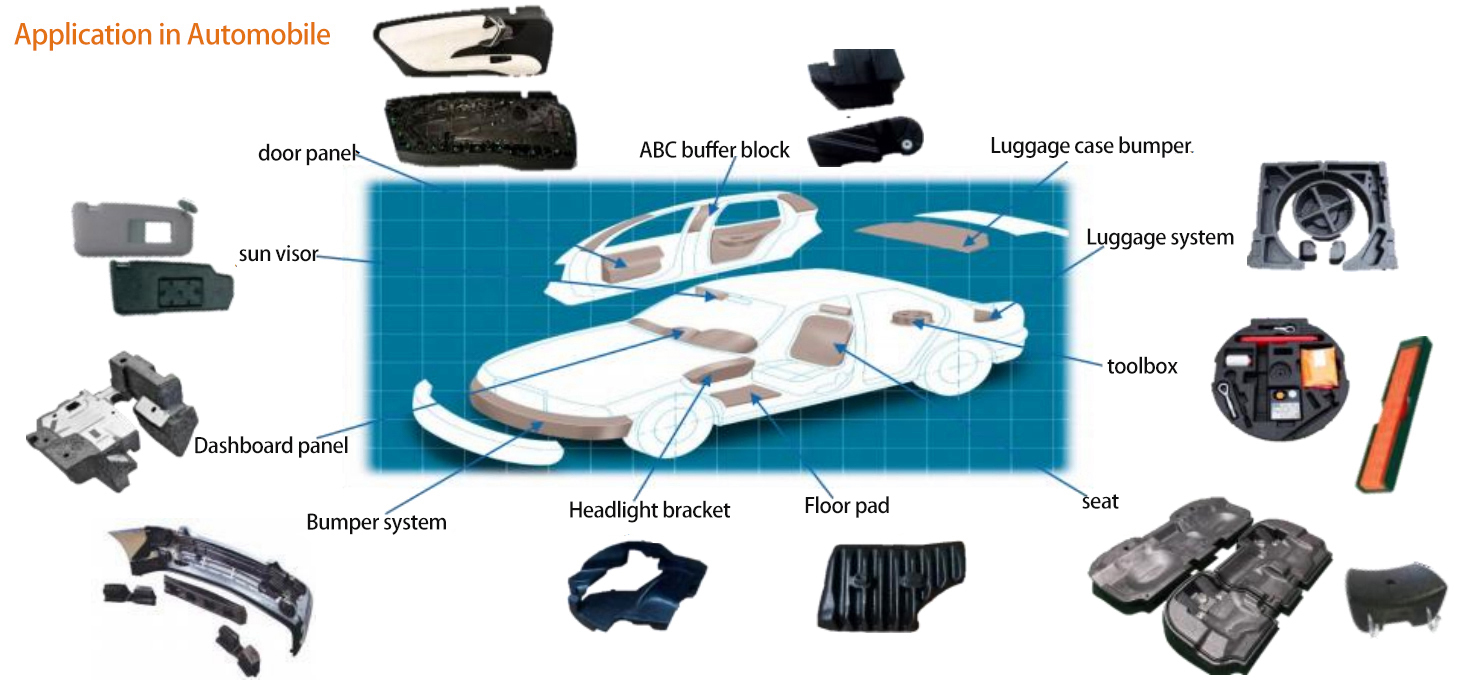
One advantage of particle foam molding is the ability to combine several geometric functions into one lightweight component.
A single molded EPP part can potentially provide support surfaces, spacing, cushioning, locating geometry, protective areas, cavities and storage features where these functions are incorporated into the approved component design.
Integrating geometry during molding can reduce secondary cutting and simplify downstream assembly for suitable projects, but the final design should be evaluated against manufacturing feasibility and vehicle-system requirements.
A component that is geometrically possible in a CAD model is not automatically suitable for straightforward particle foam molding. Complex geometry should also be reviewed for filling, forming and removal from the tooling.
Deep cavities, abrupt section changes, narrow channels and other detailed features may require additional project review before the mold configuration is finalized.
Where the design contains features that cannot be released using a conventional fixed cavity, the required tooling approach should be evaluated according to the specific component and intended molding equipment.
Complex EPP automotive parts often interface with metal, plastic, trim or other vehicle components. These interfaces should be clearly identified before tooling development.
| Interface Requirement | Information to Identify |
| Datum Surfaces | Reference surfaces used for dimensional inspection or assembly. |
| Mounting Areas | Locations that interact with clips, brackets, frames or surrounding assemblies. |
| Locating Points | Features controlling component position during assembly. |
| Clearance Areas | Required space around nearby vehicle structures. |
| Critical Dimensions | Dimensions directly affecting installation or component function. |
| Assembly Fit | How the molded part fits against surrounding vehicle components. |
Topsun's existing automotive EPP range covers finished-component densities from 30 g/L to 110 g/L.
EPP density affects component weight, firmness, support and deformation behavior. Lower-density material may be suitable where lightweight cushioning is important, while higher-density components can provide greater firmness and support.
Density should be selected together with component thickness, overall geometry, loading direction and intended automotive function rather than treated as an independent parameter.
For impact-management or safety-related components, final material and geometry should be validated according to the customer's applicable component and vehicle-system requirements.
When a custom mold is intended to operate on specified production equipment, machine compatibility should be evaluated together with the component design.
Customers should provide the available molding-machine and tooling-interface information where possible so these requirements can be considered before the project configuration is finalized.
| Equipment Information | Project Relevance |
| Machine Manufacturer and Model | Identifies the intended particle foam production platform. |
| Available Mold Space | Helps evaluate whether the component and tooling fit the available production envelope. |
| Tooling Interface | Supports review of the mounting and production configuration. |
| Mold Filling Arrangement | Relevant to filling complex cavities and component geometry. |
| Process Capability | Helps evaluate the intended material and production requirements. |
| Cooling or Vacuum Arrangement | Relevant where machine configuration affects tooling and production planning. |
Some automotive EPP components may require inserts, multiple material-density zones or other special molding functions.
If a project includes an insert, reinforcement, moving tooling feature, multi-density requirement or another non-standard production condition, this information should be provided during the initial technical review.
Feasibility depends on the finished-part design, material requirement, production equipment and intended manufacturing process and should be evaluated for the individual project before tooling is finalized.
EPP automotive components are produced through particle foam molding. Expanded polypropylene beads are introduced into a shaped mold cavity and fused to form the required three-dimensional component.
Unlike machining a complete shape from a solid foam block, particle foam molding forms the major geometry directly during the molding process and is therefore suited to repeatable production of complex lightweight components.
Actual molding conditions depend on the EPP grade, density, component geometry, tooling configuration and production equipment and should be established for each individual project.
| Stage | Project Review |
| 1. Component Application | Confirm vehicle location, component function and surrounding assembly. |
| 2. 3D Geometry Review | Review complete CAD geometry including ribs, cavities, channels and other complex features. |
| 3. Drawing Review | Confirm critical dimensions, tolerances, reference surfaces and mating interfaces. |
| 4. Material Review | Confirm EPP density and finished-component requirements where specified. |
| 5. Moldability Review | Evaluate complex geometry, part formation and component-release considerations. |
| 6. Equipment Review | Review intended molding equipment and tooling-interface information where applicable. |
| 7. Tooling Development | Develop the mold according to the approved component and production requirements. |
| 8. Mold Trial | Produce initial molded components and evaluate tooling and molding conditions. |
| 9. Finished-Part Inspection | Check dimensions, geometry, interfaces and customer-defined requirements. |
| 10. Production Release | Proceed according to approved tooling, component and production requirements. |
Tooling approval should be based on the molded automotive component and its required interfaces rather than the appearance of the mold alone.
| Validation Item | Typical Evaluation |
| Overall Geometry | Compare the molded component with the approved 3D and 2D data. |
| Critical Dimensions | Check dimensions that affect installation and component function. |
| Ribs and Cavities | Confirm required molded geometry and feature formation. |
| Channels and Recesses | Check dimensional and functional areas identified in the project drawing. |
| Mating Surfaces | Evaluate fit against surrounding vehicle components. |
| Assembly Fit | Evaluate installation in the intended vehicle or subassembly. |
| Density and Part Weight | Review against customer-defined requirements where applicable. |
| Functional Performance | Complete customer-required impact, compression, support or other validation where applicable. |
3D CAD model of the finished component
2D drawing with dimensions and tolerances
Physical reference sample if available
Automotive application and installation position
Finished component dimensions
EPP density if already defined
Component function
Critical ribs, cavities, recesses and channels
Critical mating and locating surfaces
Mounting and assembly requirements
Impact, cushioning or structural requirements where applicable
Molding machine manufacturer and model where applicable
Available tooling-interface information
Insert or special molding requirements if applicable
Trial and inspection requirements
Prototype quantity
Estimated production quantity
| Comparison | EPP Automotive Component Mold | Finished EPP Automotive Component |
| Purpose | Production tooling used to form the component | Finished vehicle foam component |
| Development Basis | Component geometry, molding equipment and production requirements | Vehicle application, density, dimensions and functional requirements |
| Density | Not a mold density parameter | 30–110 g/L within the current Topsun EPP range |
| Output | Repeatable molded component geometry | Automotive component ready for project-specific assembly or further processing |
In addition to molded EPP projects, Topsun processes multiple foam materials for automotive, packaging and industrial applications.
1. Cutting: foam materials can be cut according to customer dimensions.
2. Slicing: foam can be sliced to the required thickness for suitable applications.
3. Lamination: hot-melt film, flame and pressure-sensitive adhesive lamination are available for suitable foam materials.
4. Laser Cutting: customized foam shapes can be produced according to digital drawings for suitable materials.
5. Die Cutting: repeatable pads, gaskets, inserts and custom foam components can be produced according to project designs.
6. Compression Molding: three-dimensional molded foam and foam-composite components can be produced for suitable applications.
7. Engraving: suitable for tool-box inserts, packaging inserts and custom foam components.
8. Silk-Screen Printing: logos and patterns can be printed on suitable foam surfaces.
9. Adhesive Backing: adhesive and release liner can be applied to suitable foam products.
Topsun supplies EPP, EVA foam, PE foam, XPE foam, IXPE foam, CR foam, EPDM foam, neoprene foam, SBR foam, NBR foam and micro-cell soft PVC foam for automotive, industrial, packaging and equipment applications.
Topsun supplies molded EPP components and customized foam products for automotive component suppliers, manufacturers and industrial buyers. Customers can provide drawings, CAD models, samples, dimensions and application requirements for project evaluation.
Our facility is located in Changzhou City, Jiangsu Province, China, with convenient access to Shanghai Port for international shipments.

An EPP automotive component mold is production tooling used to form Expanded Polypropylene beads into a customized three-dimensional vehicle part.
Complex components can contain ribs, deep recesses, cavities, channels, mounting areas, locating features, curved surfaces and other integrated geometry that must be considered during tooling development.
Complex cavities and recesses can be evaluated, but feasibility depends on their geometry, depth, surrounding wall sections, component release and the intended molding setup.
Yes. Ribs, channels and other geometric features can be incorporated into suitable molded component designs and should be reviewed from the 3D CAD model before tooling is finalized.
Typical applications include bumper absorbers, side-impact components, seats, headrests, armrests, interior inserts, door components, floor structures, trunk organizers, boot fillers and protective parts.
Topsun's current automotive EPP range covers finished-component densities from 30 g/L to 110 g/L.
No. This range describes the density of the finished EPP component. Mold construction requirements are project-specific and should be evaluated separately.
A 3D CAD model is particularly useful for complex molded components because it defines the complete geometry, including ribs, cavities, channels and mating surfaces. A 2D drawing or physical sample can also provide useful project information.
Mating surfaces determine how the EPP component interfaces with surrounding vehicle parts. Critical mating dimensions should be identified so they can be checked during sample and assembly evaluation.
If the mold is intended for specified equipment, the machine model and tooling interface help the project account for the intended production configuration.
If inserts are required, provide the insert geometry, location and production requirements during the initial review. Feasibility depends on the complete component, tooling and molding setup.
Special density-zone or multi-density requirements should be identified during project review so feasibility can be evaluated against the component design and intended molding equipment.
Yes. An existing component or prototype can be used as a reference, although additional dimensions, density information and production requirements may still be needed.
Typical checks include overall geometry, critical dimensions, ribs, cavities, channels, mating surfaces, assembly fit, part density, component weight and other customer-defined requirements.
Please provide the 3D model or 2D drawing, finished component dimensions, EPP density if known, vehicle application, critical geometry, mating surfaces, molding-equipment information where applicable and estimated production quantity.
Send your project information to july@topsunfoam.com, including the component drawing or sample, dimensions, EPP density if known, application, complex geometry and available production information for evaluation.


